Identifying the Biblical Narrator’s Voice

Identifying the Biblical Narrator’s Voice

Over 50% of the Bible consists of narrative.

What do the biblical books of Genesis, Joshua, 1&2 Kings, Nehemiah, Matthew, John, and Acts all have in common? At the most basic level, they are all narratives––stories about God’s interactions with people. As every reader of the Bible is aware, many other biblical books fall into this same category. Indeed, narrative material composes more than half of the Bible. Even some books whose main genre is something other than narrative (e.g., prophetic books which contain large amounts of poetry), still contain narrative (e.g., Isaiah, Jeremiah, Ezekiel, and Hosea). This means that one of the major ways in which God decided to communicate with people is through the medium of story. Perhaps this is because everyone loves a good story, and because stories can be understood by people of all ages (although at different levels of meaning, depending on maturity). Because much of the Bible is presented in story form, this means that it contains all of the elements of a good story including: plot, characters, and a narrator’s voice. People often read the Bible without giving any thought to these, and other, ingredients of a good story. However, this article will attempt to show how paying careful attention to such details can provide a deeper understanding of biblical narrative. Specifically we will look at the critical role played by the narrator of a biblical text, and how identifying the biblical narrator’s voice can clarify a story, or even help prevent a misinterpretation. After discussing a few observations about the narrator in biblical stories, we will look at the story of Saul’s death related in 1 Samuel 31 and 2 Samuel 1. The two different versions of how Saul died has often confused people. Once we understand the role and function of the biblical narrator a solution to this problem will be more evident.

The Identity of the Biblical Narrator

Available at amazon USA / UK

In popular books, the narrator is often a device used by an author to tell a story. Therefore, the narrator and the author are usually two different people, unless it is clear that the author is telling the story in first person (I, we, me, etc.). Similarly, biblical narrative is usually told in the third person (he, she, they, or using a proper name such as “Moses said to God,” etc.). The Book of Nehemiah and the “we” sections of the Book of Acts are among the rare exceptions to this rule. “The narrator is a device used by authors to shape and guide how the reader responds to the characters and events of the story.” It is important to note that the biblical narrator “gives the impression of an all-knowing mind…a mind that in the context of the canon must be associated with God himself” (Tremper Longman III, “Biblical Narrative,” A Complete Literary Guide to the Bible, p. 75). If the narrator’s point of view can be equated with God’s, then this means that statements by the narrator are always true. “Thus any statement made by the narrator about a character or event should be accepted as factual. If it stands in contradiction to a statement made by another character, then we can know that this character is lying, deceived, or misinformed” (see my discussion in Family Portraits, p. 9), or that the biblical author has some purpose in the apparent contradiction (see my article “How many sons did Absalom have?”). Understanding the role of the biblical narrator can be crucial for correctly interpreting a passage, and the story of Saul’s death in 1 Samuel 31 and 2 Samuel 1, provides us with an excellent opportunity to put this knowledge into practice.

The Accounts of Saul’s Death in 1 Samuel 31 and 2 Samuel 1

According to the biblical narrator in 1 Sam. 31, Saul took his own life.

In 1 Samuel 31:1-5 we read of the death of Saul and his sons. Verse 3 informs us that Saul was wounded by the Philistine archers. In verse 4 Saul pleads with his armorbearer to kill him, but he is too afraid to strike Saul and so Saul falls on his own sword. Verse 5 reads, “And when his armorbearer saw that Saul was dead, he also fell on his sword, and died with him” (NKJV). Notice that verse 5 confirms Saul’s death in two ways. First, the armorbearer “saw that Saul was dead,” and second, the armorbearer killed himself the same way that Saul had and, therefore, “died with him” (my emphasis). Before looking at the description of Saul’s death in 2 Samuel 1, it is important to notice that the account of Saul’s death in 1 Samuel 31 is told by the biblical narrator. Based on our observations above about the narrator, this account should be viewed as a factual report of what happened. Indeed, there would be no reason to doubt it, if it were not for the fact that the story in 2 Samuel 1 seems to contradict it.

2 Samuel 1 rehearses the story of Saul’s death from David’s point of view. David has just returned from rescuing his wives and the families of his soldiers from the hands of the Amalekites (compare 1 Sam. 30 and 2 Sam. 1:1). David is in southern Judah in the town of Ziklag, which is a 3 day journey from the battlefield where Saul died (1 Sam. 30:1; 2 Sam. 1:2). A messenger comes to David to inform him that Israel has been defeated and Saul and Jonathan have been slain (2 Sam. 1:4). When David presses the messenger on how he can be sure that Saul and Jonathan are dead (1 Sam. 1:5), the young man relates the following story. He says that he was on Mount Gilboa and saw that Saul was badly wounded. It is what he relates next, however, that causes the reader to have what I refer to as a, “wait a minute” moment. Such a moment happens when what was previously read doesn’t seem to match the events of the current story. When the young man, who identifies himself as an Amalekite (2 Sam. 2:8), says that Saul asked him to kill him, we are reminded of Saul’s request of his armorbearer in 1 Samuel 31:4. When the Amalekite says that he complied with Saul’s request and killed him, we remember that Saul’s armorbearer had refused to do the same deed. These similarities are interesting and should cause a reader to compare the two accounts of Saul’s death. The real problem comes when we recall that the armorbearer had confirmed Saul’s death and then died beside him. Furthermore, the narrator never mentioned anything about an Amalekite being present at Saul’s death. On the other hand, the Amalekite has a pretty convincing story too because, he has Saul’s crown and bracelet in his possession (2 Sam. 1:10).

Therefore, who should we believe, or could both accounts somehow be true? Some commentators, attempt to harmonize the two stories by combining them. They reason that maybe Saul wasn’t completely dead (inspite of what the narrator says!), and that the Amalekite found him and finished him off. But this explanation has its own problems. For example, after stabbing himself, and his armorbearer believing he was dead (1 Sam. 31:5), did Saul really get back up off of the ground and lean on his spear (2 Sam. 1:6)? This would have to be the case for the Amalekite’s version to be accurate. Such details make the two stories difficult to harmonize.

Intentional Contradictions and the Danger of Artificial Harmonization

When a Bible-believer encounters what appears to be a contradiction in Scripture, the first impulse is to think of a rational explanation for it. Can the two passages be harmonized in some way? Can some other external circumstances explain away the contradiction? However, there are several problems with such attempts at harmonization. Forcing a harmonization can be like trying to fit a square block into a round hole. No matter how hard we try it doesn’t fit, but somehow we try to convince ourselves that it does! Second, whenever we consider “external circumstances” that are outside of the text, as a way of explaining the contradiction, we stop interpreting the text itself and enter the world of speculation. The world of speculation is a dangerous world because, by definition, it is something that cannot be proven. The problem with speculation is that one theory is as good as another. When we seek an explanation outside of the text, there are no longer any guidelines that confirm one explanation to be better than another. And let’s face it, sometimes speculation can lead to some bizarre explanations. However one might seek to defend speculation on a difficult passage, the biggest problem about trying to force an artificial harmonization is that we might be destroying the very thing that the biblical author intended! If the author intends for us to see a contradiction, then explaining it away will certainly lead to a wrong interpretation of the passage.

The Biblical Narrator and the Amalekite
The Amalekite's version of Saul's death contradicts the biblical narrator's version.
The Amalekite’s version of Saul’s death contradicts the biblical narrator’s version.

Recognizing that each account of Saul’s death employs a different speaker is the real solution to the problem. Is there a contradiction? Yes there is, but it is a purposeful contradiction. We have already established that the biblical narrator relates the first account of Saul’s death in 1 Samuel 31, whereas, it is the Amalekite who speaks in 2 Samuel 1. Since we have agreed that the biblical narrator always tells the truth, and since it is obvious that the passages are contradictory, then the Amalekite must, in this instance, be lying. He cannot simply be misinformed or deceived because he holds Saul’s crown and bracelet in his hands. Therefore he knows that Saul was already dead when he came upon him on the battlefield.

This conclusion is further confirmed by the biblical characterization of the Amalekites who are constantly portrayed as Israel’s enemies (e.g., Exod. 17:8-16; Deut. 25:17-19; Judg. 6:3). Moreover, Saul had previously been charged with destroying the Amalekites (1 Sam. 15:2-3) in order to fulfill what God had spoken about them in Exodus 17:14 and Deut. 25:17-19. In this same story, Samuel refers to the Amalekites as “sinners” (1 Sam. 15:18). It should also not be forgotten that David had just returned from slaughtering the Amalekites because they had burned his town and carried away all of the women and children (1 Sam. 30; 2 Sam. 1:1). Therefore, the wider biblical context, as well as the immediate context within the books of Samuel, consistently portrays the Amalekites as the enemies of Israel. The negative depiction of Amalekites in Scripture provides further evidence that the Amalekite lied to David and his men. This is additionally confirmed in 2 Samuel 4:10 where David refers back to this incident and claims the Amalekite was looking for a reward (NKJV). David’s exposure of the Amalekite’s motive further unmasks his lie. This conclusion also highlights the problem of attempting to harmonize the two accounts. Are we really to take the word of an Amalekite “sinner” and combine it with, or believe it instead of, the infallible biblical narrator?

When all of this evidence is digested it becomes clear that it would be a grave mistake to harmonize the two accounts of Saul’s death. The biblical author has deliberately set two contradictory stories side by side (This is another indication that the contradiction is deliberate; the story of Saul’s death is still fresh on our minds when we hear the Amalekite’s version.). He uses the biblical narrator to present the real facts and follows it up with the contradictory story by the Amalekite. Why does the biblical author do it this way instead of simply telling us that the Amalekite was lying? First, it makes for a much more artful telling of the story. The reader must do some detective work to arrive at the correct conclusion. Second, the contradiction causes the reader to pause and reread both accounts. This not only encourages meditation on the two passages, but it makes the irony of an Amalekite reporting Saul’s death all the more delicious. Third, it contributes to a common theme in the books of Samuel which can be referred to as “looks can be deceiving.” The Amalekite “appears” to have killed Saul, after all, he has his crown and bracelet. In this story the “looks can be deceiving” theme backfires on the Amalekite. His deception ends up costing him his own life.

In conclusion, if we try to force these two passages to harmonize, we not only miss the art of the biblical author, we also miss the important messages he sought to convey. Therefore, we should be cautious about “solving” what appears to be a contradiction in the text before examining other possibilities. It may be that the biblical author has deliberately allowed a contradiction to occur in order to communicate a certain message.

The Philistines and Their Cities

The Philistines Early History

Invasion of the Sea Peoples. For further information see http://wysinger.homestead.com/seapeople.html
Invasion of the Sea Peoples. For further information see http://www.wysinger.homestead.com/seapeople.html

Did you know that there is a lot happening in the excavation of ancient Philistine sites? The Philistines were one of the famous foes of ancient Israel. They arrived in Canaan some time around 1200-1150 B.C. and are part of the migration of the so-called Sea Peoples. The Sea Peoples consisted of various groups from the eastern Mediterranean (the Aegean region) who invaded Asia Minor (Turkey), Canaan, and Egypt during the 12th century B.C. (see map on the right). The Philistines are first mentioned in inscriptions by Ramasses III (c. 1184-1163 B.C.) who claims to have defeated them (and a coalition of Sea Peoples) after they had already overrun Canaan. The Philistines settled on the southern coastal plain of Canaan establishing five capital cities (Ashkelon, Ashdod, Gaza, Ekron, and Gath–see 1 Sam. 5-6).

This map shows the coastal area controlled by the Philistines and some of the battles they engaged in with Israel. The map is taken from http://www.bible-history.com/geography/maps/map_philistine_cities_expansion.html

The Philistines were a major threat to Israel during the later period of the Judges and into the united monarchy period. 1 Samuel 13:19-22 reveals the Philistines’ had a monopoly on iron, giving them an edge (pun intended) in weapon superiority. They first appear as a foe during the time of Samson (Judg. 13:5). Rather than rejoice in Samson’s acts of deliverance, the men of Judah insist that the Philistines rule over them (Judg. 15:11), and see him as a threat to the status-quo. During the high priesthood of Eli (while Samuel was a young man), the Philistines inflicted a major defeat on Israel, taking the ark and destroying the sanctuary in Shiloh (1 Sam. 4; Jer. 7:12). Although Samuel experienced some military success against them (1 Sam. 7:13), the Philistines inflicted another major defeat on Israel during Saul’s reign, killing Saul and several of his sons (1 Sam. 31). These incursions into Israelite territory resulted in severing the northern area of Galilee from the rest of the nation. This put Israel’s survival as a nation in jeopardy. For a short period of time David lived among the Philistines while he was running from Saul. He was given the city of Ziklag (see map on the left) in exchange for his service to Achish, King of Gath (1 Sam. 27:5-6). Once David became king of Israel, he inflicted several severe defeats on the Philistines and, from that time on, they were never again a major threat to Israel (2 Sam. 5:17-25).

Philistine Cities

Tel-Qasile

In the summers of 2008 and 2009 I had the opportunity of visiting each of the sites of the major Philistine cities except for Gaza. Archaeologists have learned much about Philistine culture and have uncovered a vast amount of Philistine artifacts. The object of the rest of this article is to introduce others to these various Philistine cities by providing some basic facts and photos. My first visit to a Philistine site was actually one that I was unfamiliar with. It is known today as Tel-Qasile and is located to the north of modern Tel-Aviv (you can locate it on the map at the top just above Joppa). The ancient name of this city is not known, but many Philistine artifacts and buildings were discovered here, including a temple.

Buildings and streets at Tel-Qasile, an ancient Philistine city
Remains at Tel-Qasile, an ancient Philistine city
Temple at Tel-Qasile
Philistine Temple at Tel-Qasile

Ashkelon

Archaeological excavations have been taking place at Ashkelon ever since 1985. At its largest extent, Ashkelon covered an area of 150 acres, one of the largest in Israel! Ashkelon is the oldest and largest seaport known in Israel and it also boasts the oldest arched city gate in the world. This gate (pictured below) dates from the Canaanite era and is roughly contemporary with the gate from Tel-Dan shown in one of my previous articles. Archaeologists have learned much about the commercial activity of this thriving seaport city. For a brief description of Ashkelon’s economics click on the following link: http://www.biblicalarchaeology.org/daily/ancient-cultures/daily-life-and-practice/the-philistine-marketplace-at-ashkelon/ For a current look at what is happening at Tel-Ashkelon see the following site: http://www.biblicalarchaeology.org/daily/digs-2014/excavating-ashkelon-in-2014/

Me at the Canaanite gate in Ashkelon, the oldest arched gate ever discovered.
More of the ruins at ancient Ashkelon

Ashdod

Among the finds at Ashdod are a 6-chambered gate, similar to those found in Israel (e.g., Megiddo, see my article), and some mycenaean (ancestors of Greek culture) pottery, characteristic of the Philistines (see photo below under Ekron for some examples). One of the interesting features of Ashdod is the museum which houses many Philistine artifacts.

Models of ancient Philistines mixed with some modern Philistines found fooling around at the Ashdod museum!
Models of ancient Philistines mixed with some modern Philistines found fooling around at the Ashdod museum! The feathered headress was a characteristic feature of Philistine military dress.
Ancient figurines used in Philistine worship from the Ashdod museum

Ekron (Tel-Miqne)

Ancient Ekron actually yielded an inscription identifying it by name. The inscription, which dates to the early 7th century, mentions the name of Ekron’s king at that time: “Achish son of Padi.” For those who know the story of David, it will be recalled that this was the name of the king of Gath that David served under during his fugitive days from Saul (1 Sam. 27–see comments above). For a picture of the inscription and its translation see the following link: http://cojs.org/cojswiki/index.php/Ekron_Inscription,_early_7th_century_BCE. At the ancient site of Ekron, I experienced a Philistine museum of a different type. This one was an outdoor museum.

IMG_4288
Outdoor museum at Ekron (Tel-Miqne). The object right of the center of the picture is an ancient Philistine loom, reminiscent of the Samson and Delilah story (Judg. 16:13-14).
Examples of classic Philistine pottery (mycenaean influence) at Tel-Miqne
This cart might be similar to the one used by the Philistines to transport the ark of the covenant back to Israel (1 Sam. 6:7-12).

Gath (Tel es-Safi)

Gath is also an extremely large site and has been undergoing excavation since 1996. In fact, one of my former students participated in an excavation there in the summer of 2009. A number of exciting discoveries have been made, including an ostracon with a name that is similar to “Goliath” (see the photo below). A large storage jar that includes the word “Rapha” (translated “giant” in 2 Sam. 21:16-22) has also been found, along with other interesting artifacts (e.g., a horned altar). For more information on the ongoing excavations at Gath click the following link: https://faculty.biu.ac.il/~maeira/

Hanging out with Philistines at Tel es-Safi (Gath). The mound in the background is the Tel, of which only a part is visible.
The goliath ostracon. Photo from: comment
The goliath ostracon. Photo from: http://gath.wordpress.com/2006/02/16/comment-on-the-news-item-in-bar-on-the-goliath-inscription/
Excavations at Tel es-Safi (Gath). This photo was taken the summer of 2008. Gath has seen 6 more seasons of excavation since then!
One area of excavations at Tel es-Safi (Gath). This photo was taken the summer of 2008. Gath has seen 6 more seasons of excavation since then!

The Philistine cities remain a rich resource for understanding their culture and biblical history. With excavations ongoing at some of these sites we will continue to increase our knowledge and understanding of one of Israel’s most dreaded foes in the ancient world. For more information on the Philistines see the websites included in this article, as well as any good Bible dictionary.

(All photos, unless otherwise noted, are the property of Randy & Gloria McCracken and are to be used for educational purposes only.)

The Moral Failure of Biblical Characters: Violence in the OT Part 7

The Moral Failure of Biblical Characters: Violence in the Old Testament Part 7

lotAnother area of the Old Testament that frequently comes under attack by the new atheists is the moral failure of biblical characters. For example, Dawkins calls attention to Lot’s drunken incest with his daughters (Gen. 19:32-36), Abraham’s lies about his wife Sarah (Gen. 12:11-15; 20:2), and Jephthah’s vow which results in offering his daughter as a burnt offering (Judg. 11:30-31, 35-40). To be honest, these stories, and others like them, disturb Christians as well as atheists. These actions by supposed “biblical heroes” are among the reasons that Christians are uncomfortable with the Old Testament. Why does the Old Testament include stories like these, and what response can Christians offer when confronted about them?

Moral Failure and False Assumptions

First, let’s begin by observing the false assumptions made by those who charge God and the Old Testament with promoting moral failure. This accusation of the new atheists gives the erroneous impression that because the Bible declares the moral failure of an individual, it must be countenancing that person’s behavior. This wrong assumption, and not the Old Testament stories themselves, is the real problem. I wonder if a similar accusation would be made about an author, whether writing a biography or novel, who included negative stories of moral failure and violence? Does that mean the author is condoning the bad behavior? We intuitively recognize that stories about violent or immoral behavior are not normally an author’s way of saying, “Here’s an example to pattern your life after!” The author does not tell the story so that we will imitate the behavior, but for some other purpose integral to the plot. The same is true with these kinds of stories in the Old Testament. They are not told so that we might imitate them, but so we might learn about the nature of sin and, hopefully, turn to God and not make the same mistakes. One Bible scholar refers to such stories as “negative example stories.”

Available from Amazon USA / UK

He writes, “Negative example stories present a character in a negative light as an example to avoid” (Robert B. Chisholm Jr., Interpreting the Historical Books, Grand Rapids: Kregel, 2006, p. 34). Some (nonbiblical) books go to great lengths to portray the hero in a positive light and the villain in a bad light. This, of course, is a distortion of reality. One difference between the Bible and other literature is that it is honest in its portrayal of people. Whether hero or villain, good traits and bad are laid bare for all to see. In fact, the consistent testimony of Scripture is that everyone, even people of faith, have faults. The greatest saints can be guilty of the most despicable sins. The reason these stories are told reflects the overall plot of Scripture which is to declare, “Everyone is in need of a Savior.”

Moral Failure and the Importance of Context

This observation points to the next response, a response we have talked about before: context! Once again, the new atheists are guilty of lifting a story from its context and holding it up as an example of God’s and the Old Testament’s depravity. Let’s take a closer look at some of these stories in context and see if there is any credibility to the new atheists’ claims. For a test case we will examine the Book of Judges, which is (in)famous for its stories of brutality. In fact, it is the Book of Judges that records Jephthah’s sacrificing of his daughter (noted above), not to mention the gang rape of a Levite’s concubine by the men of Gibeah, probably one of the most horrifying stories in all of the Old Testament. If any stories could sustain the new atheists’ claims, it would certainly be these.

Rape of the Levite's concubine
Rape of the Levite’s concubine Judges 19:22-30

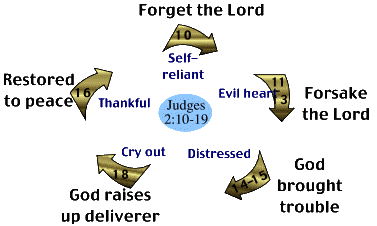
The Book of Judges is historically located following the events of the Conquest in the Book of Joshua (we have previously looked at the Conquest, see articles three and four of this series). The Book of Joshua ends with a commitment by the Israelites to follow their God Yahweh (Josh. 24:24). Although the people are far from perfect, they follow the Lord all the days of Joshua and the elders that outlive Joshua (Josh. 24:31; Judg. 2:7). Based on what we learned in lessons five and six of this series, we know that a choice for the Lord is a choice for life (e.g., Deut. 30:19-20). Therefore we are not surprised that, at this point in their history, Israel is blessed. Things change, however, at the beginning of the period of the Judges. We learn that Israel forsakes the Lord and begins to worship the gods of the Canaanites. Judges 2:11-19 is recognized as a summary statement of the book. These verses state that Israel falls into a pattern which consists of: 1) falling away from the Lord; 2) experiencing punishment (see article six in this series); 3) crying out to the Lord; 4) the Lord raising up a deliverer; and 5) the people falling back into sin after the death of the deliverer (judge) which starts the cycle all over again.

The pattern of spiritual and moral failure in Judges

It is not enough, however, to say that Israel falls into a deadly cycle. This cycle is actually a downward spiraldownward_spiral that becomes worse with every generation of apostasy. Through this downward spiral, the Book of Judges comments on the powerful negative effects of sin if left unchecked generation after generation. This pattern is evidenced through the lives of the judges. As we follow this downward spiral through the book, the judges themselves begin to show symptoms of the same degenerative qualities that have infected the people of Israel. A number of Bible commentators note that this degeneration becomes particularly evident with Gideon. After a rough start, Gideon does well, but by the end of his judgeship, he has led the people back into idolatry (Judg. 8:26-27). The story of Gideon’s son Abimelech (Judg. 9) is an interlude in the story of the Judges showing how association with the Canaanites and their gods is adversely affecting Israel (just as God had warned–Deut. 7:1-4). By the time Jephthah and Samson arrive on the scene, they are as depraved as the people they are supposed to rescue. Jephthah’s offering of his daughter as a sacrifice is not told as an example of piety, but as an example of what happens when God’s people allow themselves to be affected by the idolatrous culture around them. It is not accidental that the enemies Jephthah fought against were the Ammonites (Judg. 11:6) and (apparently) the Moabites (Judg. 11:15-18). Child sacrifice was a feature of the worship of Milcom (sometimes called “Molech”) the god of the Ammonites (IVP Bible Background Commentary, pp. 132-133, 365). The Moabites were also known for practicing child sacrifice (2 Kgs. 3:26-27) and their chief god Chemosh is specifically mentioned by Jepthah (Judg. 11:24). Through Jephthah’s rash (and unprovoked) vow, the story makes a negative comment on him and other Israelites who have allowed themselves to become infected by the culture of their enemies. As Bible commentator Daniel I. Block states, “Far from being agents of spiritual change, the deliverers demonstrated repeatedly that they were a part of the problem rather than a solution” (Judges, Ruth, New American Commentary, p. 40).

Available at Amazon USA / UK

Another way in which the Book of Judges describes this degeneration is through the increase of violence in Israelite society. This is particularly evident in the portrayal of women. The beginning of the Book of Judges depicts several strong independent women. One (Achsah) is a landowner confidently asserting her rights before her father (Judg. 1:13-15), another (Deborah) is a prophetess and Judge (Judg. 4:4-5) who inspires even the men to be courageous (Judg. 4:8), while a third (Jael) is a heroine aiding Israel in the defeat of a feared enemy (Judg. 5:24-27). By the end of the book, however, the image of the strong independent woman is replaced by the image of woman as victim. Women are raped, kidnapped, and treated as chattel (Judg. 19:25-29; 21:20-23). Far from condoning violence and the mistreatment of women, the Book of Judges graphically portrays what happens when a society abandons God so that everyone can do what is “right in their own eyes” (Judg. 17:6; 21:25).

Moral Failure Exemplified: The Canaanization of Israel

If readers are shocked at this kind of behavior, then the Book of Judges has achieved at least one of its purposes. Atheists and unbelievers are up in arms about these stories, as they should be, but what they fail to realize (or ignore) is that: “The theme of the book is the Canaanization of Israelite society during the period of the settlement” (Block, p. 58). In other words, it is ironic that the atheists who want to protect the poor Canaanites from the wrath of Israel’s God, become indignant when faced with Canaanite-like actions! What we see at the end of the Book of Judges is not the way God has instructed His people to live. What we see are the effects of Canaanite culture on Israel! The atheists cannot have it both ways. If they want to defend the lifestyle of the Canaanites, then they must defend the rape of the Levite’s concubine as perfectly permissible; otherwise,  they must recognize the justice of God in seeking to eliminate such behavior. By the way, this is why Israel, as well as Canaan, gets a taste of God’s judgment in the Book of Judges. Once again, far from being xenophobic (as the new atheists insist), God shows Himself to be no respecter of persons.
In the end, we must marvel that the justice of God leaves anyone standing! This is a testimony to God’s incredible longsuffering and kindness, desiring all to repent and come to life. This is the other amazing message in the Book of Judges, and once again we see another Old Testament book whose stories are bathed in the context of God’s grace.

Words and the Word: Book Review

Words and the Word: Book Review

Words and the Word, available at amazon!
Words and the Word, available at amazon USA / UK

Words and the Word: Explorations in Biblical Interpretation and Literary Theory, eds. David G. Firth, and Jamie A. Grant, (Nottingham: Apollos, 2008). Available at IVP

Words and the Word, as the subtitle suggests is a book about “Explorations in biblical interpretation and literary theory.” This book seeks to explain and demonstrate the significance of different literary approaches to the Bible. It argues for a well-rounded, in-depth approach to bible study from an evangelical point of view and engages with some of the techniques employed by practitioners of literary theory. If all of this sounds a little “heady,” it is, so be forewarned. However, there is much of practical insight as well.

Words and the Word is divided into two parts. Part 1 is entitled “General issues,” and consists of two articles that provide an overall introduction to the subject from slightly different perspectives. They are entitled: “Literary theory and biblical interpretation,” and “A structural-historical approach to exegesis of the Old Testament.” Part 2 takes a look at some of the “specific approaches” utilized in literary studies. These include: “Speech-act theory,” “Genre criticism,” “Ambiguity,” “Poetics,” “Rhetoric,” and “Discourse analysis.”

Can We Discover the Meaning of the Word by its Words?

In the introductory article to Part 1, Grant R. Osborne argues that “Every aspect of the hermeneutical process is immersed in literary theory because every part of Scripture is literature” (p. 48). Osborne states that the goal of literary interpretation is the meaning of the text. However, modern literary approaches have suggested different means by which that meaning is derived. Osborne argues against the post-structuralist approach which contends that meaning resides in the reader, rather than in what the author intended. The danger with this approach is that the text has no inherent meaning, but it means whatever a particular reader thinks it means. Osborne advocates a 3-pronged approach which includes the author who produced the text, the text itself as a historical document which is open to historical analysis, and the reader who studies and interprets the text using historical and grammatical methods to arrive at the meaning. Through this approach Osborne believes that “the most likely meaning of a text can be discovered” (p. 48). This might seem like an argument that only concerns scholars and intellectuals, and therefore irrelevant to the average person studying the Bible, but actually there is a point here for everyone.  At times many Bible students are guilty of the approach “I think this passage means X,” without doing a proper study of the passage. The practical result of this approach (“this is what it means to me”) is no different from the intellectual who uses complex arguments to justify such an approach. Therefore, Osborne’s arguments need to be heard by evangelicals.

Beyond the theoretical issues, Osborne gives some practical examples of the value of a literary approach, focusing his examples on the Gospels. For example, Osborne notes that the Gospel of John “is well known for using synonyms theologically.” We have all heard the interpretation that Peter’s use of phileo (brotherly love) as opposed to Jesus’ use of agape (divine love) is significant. But Osborne argues the significance does not lie in the change of verbs because this is something that John frequently does in the Gospel. Therefore, one who makes this the point of the story actually misses John’s real message (pp. 32-33).

In the second article of Part 1 S. N. Snyman insists that in a literary approach to Scripture, one cannot ignore the historical dimension, but must include it in any analysis of the text. Basically, Snyman focuses on exegesis: what it is; why it is important; and how to do it.

Investigating and Illustrating Various Types of Literary Approaches

Rather than summarize each chapter of Part 2, I will comment on a few of the methods and what I found particularly helpful. Firth’s chapter on “Ambiguity” in Scripture is very insightful. . Firth identifies 3 different ways in which we may encounter ambiguity. First, is ambiguity that is intended by the author. Second is what I would call “accidental ambiguity.” This is when a word or phrase might have more than one interpretation in a context, but the ambiguity was not intended by the author. For example, it is not clear in 1 Samuel 16:21 whether Saul loves David or David loves Saul. The third kind concerns ambiguity on the reader’s part, which may be caused by a number of factors, including historical distance from the event being described, lack of understanding the culture, etc. Firth clarifies that the type of ambiguity he is focusing on is the first kind which involves an author’s intentional use of ambiguity. Next Firth discusses the theory and definition of ambiguity as found in the work of William Empson and refines Empson’s 7 types of ambiguity to 5. These types include: 1) Details effective in multiple ways; 2) Multiple possibilities with a single resolution; 3) Simultaneous use of unconnected meanings; 4) Alternative meanings combine to clarify author’s intention; and 5) Apparent contradictions. A list of these types of ambiguity is indeed vague so Firth pursues a definition and seeks to illustrate each type from Scripture. He concludes with a marvelous example from 1 Samuel demonstrating how the author uses ambiguity to highlight Saul’s character flaws. This was my favorite chapter in the book and was extremely helpful in demonstrating how biblical authors might use ambiguity as a literary technique in communicating a message.

The chapter entitled “Poetics” takes a look at the Wisdom literature of the Old Testament, particularly the Book of Psalms (a brief paragraph at the end of the chapter is also dedicated to poetry in the NT). In this chapter author, Jamie A. Grant. looks at some of the new developments in the study of the poetic literature of the Bible. In particular, he advocates taking a more holistic approach to the Book of Psalms by noting how the book is structured. We have tended to interpret each psalm individually, but Grant notes that the Book of Psalms is broken down into 5 different “books” by the biblical editors. He also points out that certain psalms are grouped together by themes (such as the Songs of Ascent–Ps. 120-134). Becoming aware of these groupings can enable one to see how these psalms interact with each other. Furthermore, noticing the structure of a section of psalms may also reveal insights that otherwise go unnoticed. For example, Grant points out that Psalms 15-24 are arranged chiastically. Psalm 19, a psalm about the Law, is the center point of the chiasm which suggests its significance.

The last chapter of Words and the Word, looks at “Discourse Analysis.” Discourse analysis involves using all of the techniques and approaches discussed in this book, plus more. Therefore, this forms a fitting conclusion to the book. The author, Terrance R. Wardlaw Jr., provides two examples of discourse analysis; one from the OT (Exodus 15:22-27) and the other from the NT (Matt. 5:1-12), illustrating the value of various approaches. Wardlaw’s examples are very helpful in illuminating the process of discourse analysis, and they also provide an insightful look at these two texts.

Evaluation of Words and the Word

There is a lot to learn from Words and the Word. However, one of the shortcomings of the articles that comprise this book is that the discussion of theory can often be very abstract. To one who is not familiar with these approaches, or who has problems thinking abstractly, this can be a challenge. Illustrations of the various approaches are the saving grace of this book. However, some authors achieve this success better than others in my opinion. I found a few of the chapters to be difficult wading, nearly drowning me in theory without practical application. This book is definitely not for the average Bible reader. It is suited more for the advanced student or scholar. I would not even recommend it for most pastors. Although there are many valuable insights, and even some sermon fodder here, the average pastor is probably too busy to wade through all of the abstract discussion to benefit much. Although Words and the Word seeks to fill the gap between more indepth discussions of literary theory and introductory Bible study, it strongly leans in the direction of the more advanced student. Therefore I would recommend it to those who have a basic familiarity with literary approaches and want to go deeper, but not to the average student of the Bible. These approaches are important and yield valuable insights, but a book is still needed that can communicate these ideas in a less complicated more “learner friendly” manner.

Words and the Word is available at Amazon USA / UK

(I would like to thank IVP for this copy of Words and the Word, in exchange for an unbiased review.)

“You Reap What You Sow”: Violence in the Old Testament Part 6

“You Reap What You Sow”: Violence in the Old Testament Part 6

What-You-Sow-Is-What-You-ReapIn my last article I looked at the nature of God and sin as a reason for the need of judgment (I would encourage you to read or reread that article before continuing, as many of the ideas presented there are important for the discussion here). In this article I will provide a second reason for judgment. The easiest way to sum up this response is with the biblical teaching “You reap what you sow” (e.g., 1 Kgs. 2:32; Hos. 8:7; Gal. 6:8). Although many passages declare that God brings judgment on wicked human beings, the Bible also teaches that sinful people experience the consequences of their own choices, bringing judgment on themselves. Perhaps one of the clearest statements of this principle is found in Psalm 7:14-16: “Behold the wicked brings forth iniquity; Yes, he conceives trouble and brings forth falsehood. He made a pit and dug it out, and has fallen into the ditch which he made. His trouble shall return upon his own head, and his violent dealing shall come down on his own crown” (NKJV).

Proverbs, Esther and the Theme “You Reap What You Sow”

Previously I noted that, since God is the Author and Giver of life, any choice that excludes God is a choice of death. If this logic is pursued, then it becomes clear that we bring judgment on ourselves by making the wrong choices. This idea is stated clearly throughout the Book of Proverbs. One of the best examples concerns the speech of Lady Wisdom in chapter 8. In Proverbs 8, Wisdom claims to have been with the Lord before the creation of the world, as well as present at creation (Prov.. 8:22-31). Everything said in these verses parallels what we previously established about God’s Word (see Part 5 of this series). It is not surprising then when Wisdom states, “For whoever finds me finds life, and obtains favor from the Lord; but he who sins against me wrongs his own soul; all those who hate me love death” (Prov. 8:35-36–italics are mine for emphasis).

Haman hanged on his own gallows. Courtesy of the Digital Image Archive, Pitts Theology Library, Candler School of Theology, Emory University

Stories in the Old Testament frequently illustrate this theme. In fact, some of the acts of violence which are recorded are not acts sanctioned by God, and this violence results in the culprit(s) experiencing the principle: “You reap what you sow.” The story of Haman, recorded in the book of Esther, is an example of this. Haman hated a man named Mordecai, the uncle of Queen Esther, because Mordecai would not bow down before him and show him the proper respect he thought he deserved (Esth. 3:1-6). As a result, Haman planned to have Mordecai hung on the gallows he had constructed, as well as have the Jewish people massacred (Esth. 3:8-15; 5:14). In the end Haman’s plan was uncovered and he was hanged on his own gallows (Esth. 7:4-10).

The Flood and the Theme “You Reap What You Sow”

The Flood resembles the statement in Gen. 1:2

Although the story of the Flood is portrayed in Genesis as God’s judgment on His creation (Gen. 6:7), there is another sense in which humans bring judgment upon themselves. Last time we noticed that Genesis 1 teaches that the Word of God created structure and order out of what was “formlessness and void” (Gen. 1:2) resulting in a good creation (Gen. 1:31). We also noted that sin is a disregard of God’s Word which results in crossing over, or destruction of, the good boundaries He has put in place. The example of a house with walls, doors, and structural beams was used as an analogy to illustrate that order and structure are necessary for a quality existence. To commit sin is similar to knocking out the beams and walls that hold the structure in place. When enough damage is done, the roof caves in. The story of the Flood is told similarly.
Genesis 6:1-6 describes the growth of sin in God’s creation until it is said, “Then the Lord saw that the wickedness of man was great in the earth, and that every intent of the thoughts of his heart was only evil continually” (Gen. 6:5–my emphasis). The description continues in verses 11-12 stating, “The earth also was corrupt before God, and the earth was filled with violence. So God looked upon the earth, and indeed it was corrupt; for all flesh had corrupted their way on the earth” (Gen. 6:11-12). In other words, all of the good order and structure that God had built into His original Creation had eroded away. Instead of the good quality of life that God had created, there was only violence and corruption. As a result of humans kicking out all of the God-given structure that God had put in place, the roof caved in on them and the ground gave way beneath them (Gen. 7:11). If this seems like stretching the language a bit, all one needs to do is check out the language of Genesis 7 (a good modern commentary such as Kenneth A. Mathews, “Genesis 1:-11:26” vol. 1 New American Commentary, p. 376 is also helpful). Genesis 7 purposely recalls the language of Creation in Genesis 1 using similar expressions found there (e.g., Gen. 7:14–”every beast after its kind, all cattle after their kind, every creeping thing that creeps on the earth after its kind, etc. Compare Gen. 1:24-25). The difference is that the language of the Creation story occurs in reverse order in Genesis 7 until the world returns to the formlessness and void of Genesis 1:2. The message is clear: not only has God judged His creation, human beings through their sin, have “reaped what they had sown.”
This message comes through in another way in Genesis 6. After God tells Noah in verses 11-12 that the earth is “filled with violence” and “corrupt,” He pronounces judgment on it by saying in Genesis 6:13, “for the earth is filled with violence through them; and behold I will corrupt (NKJV reads “destroy”) them with the earth.” In other words, God uses the same word to speak of destroying the earth that describes the sin of the people. There are two potential messages here: 1) God’s judgment is fair; Just as people “corrupted” the earth through sin, so He “corrupts” it in judgement; and 2) people have brought judgment down upon themselves. By using the same verb for judgment that describes peoples’ sin, the Bible is declaring, “You reap what you sow.”

When God Takes His Hand Off the Wheel

When God lets go, you reap what you sow!

Another way of looking at this biblical teaching is by saying that God simply takes His hand off of the controls and allows people to experience the consequences of their actions. Again, this is much like a parent who has warned their child to no avail, and finally realizes that they will only learn by experiencing the consequences of their actions. Some will object that the consequences God allows are more severe than what a parent would allow. However, this objection fails to take into account two important factors: 1) the destructive nature of sin (which we established in the previous article leads to death); and 2) the matter of human freewill. Ultimately a parent is helpless if their child exercises free will by destroying their lives with drinking, drugs, or suicide. So it is not true that a parent would not allow their child to experience serious consequences. Sometimes they have no choice! Sin has its consequences and neither a parent or God can prevent those consequences when someone is determined to go in a deadly direction. As we previously established, departure from the God of life, results in death. If God stopped a person from making decisions that led to harmful consequences, then the atheist would complain that God is unfair for not allowing free will. If God allows free will, then He is considered a moral monster for allowing the choices that people freely make to destroy themselves and others. Either way, God cannot win!

Romans 1 and the Theme “You Reap What You Sow”

Romans 1 is an example of the principle we have been talking about. This passage is particularly important for what it teaches about the nature of free will and God’s wrath. In Romans 1:18 Paul’s discussion begins with the statement: “For the wrath of God is revealed from heaven against all ungodliness and unrighteousness of men….” When we hear the words “wrath of God” we immediately expect to read of God sending thunderbolts or other calamities to “let people have it” for disobeying Him. In fact, what Paul says, and this is repeated three times, is that “God gave them over” (Rom. 1:24, 26, 28). In other words, those who don’t want to follow God and insist on going their own way are permitted to do so. This permissiveness of God is an expression of His wrath according to Paul! God simply allows people to do what they want to do and to reap the consequences for their actions. This is then a passive way in which God’s wrath is expressed. God actually does nothing. He takes His hand off and allows us to do what we want. Since what we want has nothing to do with God, the Giver of life, then our choice leads to death (Rom. 1:18-32). This is the same message then that was taught in the Old Testament and once again it can be summed up in the statement: “You reap what you sow.”
Even though this all sounds like bad news, we must not forget the context of grace in which even God’s judgments are set (see Part 4 of this series). The good news is that God has provided a way to escape the power of sin and death (e.g., Rom. 7:24-25). God gives us the freedom to choose, for love must involve freedom of choice. However, the story of Scripture is that whenever people have chosen the path that leads to death, God has always graciously provided a way back to the path of life. That remedy is the free gift of His Son Jesus (Rom. 6:23) and it is received when we repent. Repentance means we turn from the path of death we are on, and turn back to God and the path of life He has illumined for us by His Word.
Near the beginning of this article, I mentioned that a number of the acts of violence spoken of in Scripture are not sanctioned by God. Atheists often refer to such passages claiming that the Bible endorses violence. I will take a closer look at this idea in the next installment of “Violence in the Old Testament.”