Biblical Narrative: How Motifs Enrich a Story

Biblical Narrative: The Use of Motifs

A Viking embroidery motif. Biblical narratives use a similar pattern of repetition.
A Viking embroidery motif. Biblical narratives often  use imagery with similar patterns of repetition.

A motif is a recurring pattern or design, or a familiar image that is repeated in a piece of writing such as a biblical narrative. In my last post on “Helpful Suggestions for Bible Study,” I focused on the importance of paying attention to the details of a story (you can read that post here). Another detail that is often overlooked in Bible study is the recurrence of motifs within a story, or even a whole book. Biblical narratives commonly use motifs. These motifs spice up a story and not only increase the “entertainment” value of the story, but usually contribute to the understanding of an important theme, message, or character within the narrative. This is a “detail” worth pondering, and so I would like to take the opportunity in this article to look at various stories and the motifs found in them. With some stories, the reason for the motif is obvious. With other stories, the reason for the motif is more obscure. In this article I will explore the meaning of some motifs while asking all of you who read this blog to offer insights and suggestions about others. I hope you’ll join me by sharing your comments. So let’s have some fun exploring various motifs in biblical narratives and see what we might learn from them.

A stone becomes Jacob's pillow and that night God appears to him in a dream.
A stone becomes Jacob’s pillow and that night God appears to him in a dream.

Stones are a common motif in some biblical narratives. For example, the story of Jacob, in the Book of Genesis, frequently refers to them. When Jacob has his famous dream of the “ladder” that reaches from heaven to earth, we are told that he uses a stone for his pillow (Gen. 28:11). The following morning he takes the same stone and sets it up as a sacred pillar (yes, his pillow becomes a pillar) for a memorial of the occasion (Gen. 28:18, 22). The stone here is obviously a motif that suggests God’s provision, protection, and blessing on Jacob, as he flees from his brother Esau and goes to Syria where he will meet his future wives (Leah and Rachel) and encounter his diabolical uncle Laban, but it also suggests Jacob’s lack of certainty about God. Upon Jacob’s arrival in Syria (Paddan Aram), he comes to a well which has a large stone that covers it (Gen. 29:2). The narrator spends several verses talking about this stone and the shepherds’ reluctance to remove it quickly (Gen. 29:3, 8). However, when Rachel arrives on the scene and Jacob sees her for the first time, we are informed that he rolls the stone away by himself and waters the flocks (Gen. 29:10)! The contrast between the lazy shepherds and the energetic Jacob, the heaviness of the stone and the appearance of Rachel, seems to suggest that Jacob is showing a little machismo and flexing his muscles for the little beauty he has just met! In this case, the stone represents Jacob acting in the flesh. Up to this point in the story it must be admitted that Jacob relies on himself, rather than on God. Jacob secures Rachel as a wife by showing off, working hard, and bargaining with Laban (Gen. 29:18-19). It is all done in his own strength. By contrast, his father Isaac had received his wife through the fervent prayer of Abraham’s servant who sought God’s guidance each step of the way (Gen. 24). Jacob never prays about a wife. He flexes his muscles, works hard, and negotiates.

Stones are a biblical narrative motif. The heap of witness (Gen. 31:44-55)
The heap of witness (Gen. 31:44-55) One example of the use of stones in the biblical narrative of Jacob

After years of mistreatment at the hands of his father-in-law, stones reappear again in the story of Jacob as he and his family flee from Laban. The stones in this story represent a covenant (Gen. 31:44-46), but the covenant is based on hostility and mutual mistrust (Gen. 31:51-52). For Jacob they also appear to have the deeper meaning of recognizing God’s protection over him (Gen. 31:53). In Genesis 35, Jacob finally returns to Bethel (where he had his original dream). God appears to him and reiterates all of the promises He had made to Jacob. When God is finished speaking, the Scripture tells us that Jacob set up a “pillar of stone” to commemorate where God had talked with him (Gen. 35:14). This scene brings the story full-circle demonstrating both God’s faithfulness to Jacob and Jacob’s trust in God. The first stone pillar at Bethel (Gen. 28) was set up by a lying and deceitful Jacob who trusted in his own wits and strength. The final stone pillar at Bethel (Gen. 35) is set up by a Jacob who has learned humility, trust, and dependence on God. Jacob’s trust in God is declared one final time through this “stone” imagery. On his deathbed, as he is blessing his son Joseph, Jacob refers to God as “the stone of Israel” (Gen. 49:24). Thus by following the “stone” motif in the story of Jacob we can not only discover significant insights into the personality of Jacob, but we can discover the message of how God transforms a self-sufficient man into one who depends on Him.

Saul's spear was his constant companion and is an example of another literary motif in a biblical narrative.
Saul’s spear was his constant companion and is an example of another literary motif in a biblical narrative.

Another motif that Bible commentators frequently draw attention to is the spear of Saul. Following the story of David and Goliath, a spear becomes Saul’s constant companion (1 Sam. 18:10-11; 19:9-10; 20:33; 22:6; 26:7-22). Some wonder about the frequent reference to Saul’s spear but have no explanation for it. Others suggest that it is a sign of his kingship. To a certain extent this is true, but this insight needs to be taken further. The real key to understanding the significance of Saul’s spear is found in David’s statement to Goliath, “You come to me with a sword, a spear, and with a javelin, but I come to you in the name of the Lord of hosts” (1 Sam. 17:45). Most significantly, David states, “Then all this assembly shall know that the Lord does not save with sword and spear; for the battle is the Lord’s, and He will give you into our hands” (1 Sam. 17:47). David’s statements to Goliath cast a shadow over one who puts his trust in a sword or a spear. As mentioned above, it is after these statements by David that the biblical narrative constantly draws attention to the spear that accompanies Saul. The spear becomes a symbol of Saul’s trust in the flesh and his lack of trust in God. This is especially clear when he attempts to use this spear to rid his kingdom of David, God’s anointed (1 Sam. 18:10-11; 19:9-10). Thus, Saul’s spear represents his conflict with God. By seeking to kill David, he is opposing God and God’s plan for the kingdom. This is part of the significance of David taking Saul’s spear (1 Sam. 26:7-22). God (through David) disarms Saul and demonstrates who the true king of Israel is. Reflecting on the people’s original request for a king (who turned out to be Saul), we are reminded that they asked for a king “to judge us like all the nations” (1 Sam. 8:5). Saul’s trust in his spear rather than in God, suggests that he is a king “like all the nations” and, therefore, the people got the kind of king that they asked for!

Biblical narrative: Samson sets the Philistine fields on fire.
Samson sets the Philistine fields on fire. Fire is a frequent motif in the biblical narrative of Samson.

Samson’s name is from the Hebrew word for “sun” and fire is a recurring motif in his story. When Samson’s wedding guests are not able to solve his riddle, they threaten to burn his wife and father-in-law with fire (Judg. 14:15). The most famous incident involving fire in connection with Samson is when he captures 300 foxes, ties torches to their tails and releases them into the fields of the Philistines to destroy their harvest (Judg. 15:5). In retaliation for this incident, the Philistines fulfill their threat against his former wife and father-in-law by burning them with fire (Judg. 15:6). After Samson responds by attacking more Philistines, they demand that the tribe of Judah hand him over. Samson agrees to allow his fellow-Israelites to tie him up, but when he is handed over to the Philistines we are told, “Then the Spirit of the Lord came mightily upon him; and the ropes that were on his arms became like flax that is burned with fire” (Judg. 15:14). Similarly, when Delilah ties Samson up with bowstrings and says “The Philistines are upon you Samson,” he breaks the bowstrings, “as a strand of yarn breaks when it touches fire” (Judg. 16:9). What we are to make of all of these references about fire, and Samson’s name (which actually means “little sun” or “sunny”) is uncertain. However, fire is clearly a motif of the story. Because many in the ancient world worshipped the sun, some see Samson’s name in a negative light (no pun intended!). Certainly, he was the worst of the Judges. But in spite of his self-indulgent ways, he does bring partial deliverance to Israel. The fire motif is connected with this theme of deliverance from the Philistines. So what should we make of this motif in the story of Samson? I would be interested in hearing what some of you think.

I find the motifs of various biblical narratives an interesting way to approach Bible study. I’ve even thought of one day writing a book on some of the motifs of 1&2 Samuel. We have already looked at the motif of the spear in 1 Samuel. Let me conclude this article by mentioning two more. The motif of feet and lameness appears in the early chapters of 2 Samuel. Asahel is said to be “fleet of foot” (2 Sam. 2:18), while David laments the death of Abner by stating, “Your hands were not bound; Nor your feet put into fetters” (2 Sam. 3:34). In 2 Samuel 4:4 we are introduced to Jonathan’s son Mephibosheth who is “lame in both feet.” In 2 Samuel 5 when David attacks Jerusalem, the Jebusites taunt him by saying “You shall not come in here; but the blind and the lame will repel you” (2 Sam. 5:6). More talk about the blind and the lame continues in 2 Sam. 5:8. By the end of 2 Samuel 9, Mephibosheth, the man lame in both feet, is sitting at the king’s table (2 Sam. 9:13).

Mephibosheth, the man lame in both feet, eats at the king's table.
Mephibosheth, the man lame in both feet, eats at the king’s table.

Speaking of the king’s table, another very interesting motif that runs through the biblical narrative of 1&2 Samuel, is the motif of eating and not eating. This motif is so widespread that I will only mention a few examples (for a fun study, see how many others you can find!). In 1 Samuel 1:8 Hannah refuses to eat. In 1 Samuel 2, Eli and his sons cannot help but eat everything in sight, including the sacrificial meat that belongs to God (1 Sam. 2:12-17; 27-30). There is definitely a contrast being made between Hannah who refuses to eat what she is entitled to, and Eli and his sons, who eat what they are not entitled to. Other examples include: Saul putting the army under a vow of fasting until he defeats the Philistines, but Jonathan eats some honey unaware of Saul’s command (1 Sam. 14:24-30); Jonathan refusing to eat at the table with Saul because he is grieved over Saul’s desire to kill David (1 Sam. 20:34); Saul’s visit to the “witch” at Endor where he is persuaded to eat after initially refusing (1 Sam. 28:20-25); as noted above, Mephibosheth is invited to eat continually at King David’s table (2 Sam. 9:7-13); David refuses to eat as he prays for the child that Bathsheba has given birth to, but once the child dies, David eats (2 Sam. 12:16-23); and Amnon requests food from his sister Tamar, but then refuses to eat it (2 Sam. 13:5-11). These are only a few of the many stories that contain the theme of eating and not eating in 1&2 Samuel. This motif seems to have different meanings depending on the context and I look forward to exploring it in more depth in the future. Meanwhile, if you have any thoughts regarding this motif or others not mentioned in this article, I would welcome hearing them.

Hopefully this brief survey of a few of the motifs in biblical narrative will encourage you in your Bible study. The Bible speaks at many different levels and motifs can be an interesting way of entering into the meaning of a story.

Robert B. Chisholm Jr’s Comments on Violence in the Old Testament

Robert B. Chisholm Jr’s Comments on Violence in the Old Testament

Robert B. Chisholm Jr.

This past summer I had the pleasure of conducting an interview with Robert B. Chisholm Jr., department chair and professor at Dallas Theological Seminary. The interview was primarily about his new commentary on 1&2 Samuel (you can see the entire interview here). However, I did take the opportunity to ask him about his views on Violence in the Old Testament. As part of my on-going series, I thought I would repost his comments on this topic. Bob’s comments particularly focus on the idea of justice and the biblical concept “you reap what you sow” (see my treatment of this idea here). I have reproduced Bob’s comments as they originally appeared in the interview. The only change I have made is to include Scripture references that were not part of the original interview so that the interested reader does not need to look them up. If it’s been awhile since you’ve read these comments, or if you’ve never read the entire interview, I hope you enjoy the following recap.

Here is my question followed by Bob’s answer.

I am currently writing a series of articles on my website entitled “Violence in the Old Testament.” This seems to be an important topic given the publications of books by the “new atheists” such as Richard Dawkins and Christopher Hitchins. Christians are often embarrassed about the violence in the Old Testament and many shy away from reading and studying it. I know this is a big topic but do you have any comments you’d like to share on this subject, especially as it relates to the books of 1&2 Samuel?

This is also a topic of great interest for me and I hope to do more writing on it in the days ahead. At the 2011 national meeting of the Evangelical Theological Society, I delivered a paper entitled: Fighting Yahweh’s Wars: Some Disturbing Acts of Violence in Judges-Samuel. It should be published soon; I’m still working on the logistics of where. I study six different episodes where God endorses violence. I am not as apologetic as some and prefer to give God the benefit of the doubt. It’s a messy fallen world filled with a lot of evil people and sometimes God rolls up his sleeves, so to speak, and enters into the fray as the just Warrior-King. Here’s the conclusion to my paper: A close reading of these six accounts reveals that in each case the act of violence involved the implementation of divine justice against the object. In two instances (Adoni-Bezek–Judg. 1:5-7, and Agag–1 Sam. 15:32-33) an individual was treated in a way that mirrored his crimes against others. In four cases a people group (the Amalekites–1 Sam. 15) or representatives of a people group (the Moabite king Eglon–Judg. 3:14-25, the Canaanite general Sisera–Judg. 4-5, the thirty Philistines murdered by Samson–Judg. 14:15-19) were, at least from Yahweh’s perspective, the objects of violent acts of justice in response to crimes committed or intended (in the case of Sisera) against Israel. In Goliath’s case (1 Sam. 17), David refused to view the Philistine’s taunt as simply a verbal assault against Israel’s army. Yahweh identifies with his people and so he was the ultimate target of the Philistine’s slander. Consequently, David’s victory over Goliath was an act of justice that vindicated Yahweh’s honor by punishing a blasphemer.

Though these violent acts are disturbing at an emotional level, they are, as acts of justice, gratifying at a deeper, more elemental level. Ultimately, it is not worth living in a world in which there is no justice. Such a place would be nothing more than a jungle in which superior strength breeds arrogance and evil, and the strong take what they want, dishing out pain and suffering with reckless abandon. But justice, to truly be justice, must be implemented fully and appropriately. To use a contemporary example, when the Harry Potter saga finally reaches its climax, Nagini, Bellatrix Lestrange, and, of course, Voldemort cannot just die; they must be killed the “right way” for justice to be satisfied and for some sense of moral equilibrium to be realized. Bellatrix cannot be pitied as long as the image of a dying Dobby persists in the mind’s eye.

So it is in the biblical story: Those who cut off the thumbs of others or make mothers childless eventually discover that what goes around comes around. Those who attack, oppress, and abuse Yahweh’s people eventually pay the price in “the right way.” Those who dare defy the living God and challenge him to step into the arena may end up a decapitated torso. And though the scene may make one want to vomit, in the end the image prompts a sigh of relief and more. As the psalmist declares: “The godly will rejoice when they see vengeance carried out; they will bathe their feet in the blood of the wicked. Then observers will say, ‘Yes indeed, the godly are rewarded! Yes indeed, there is a God who judges the earth!’” (Ps. 58:10-11) In conclusion I leave you with this scene: “Then I saw heaven opened and here came a white horse! The one riding it was called ‘Faithful’ and ‘True,’ and with justice he judges and goes to war” (Rev. 19:11). Even so, come Lord Jesus!

For a list of some of Robert B. Chisholm Jr’s works click on the links here for Amazon USA / UK

The IVP Bible Background Commentary Part 2: Genesis – Kings

The IVP Bible Background Commentary Part 2: Genesis – Kings

untitledTHE IVP BIBLE BACKGROUND COMMENTARY: Old Testament. By John H. Walton, Victor H. Matthews, and Mark W. Chavalas. Downers Grove: InterVarsity Press, 2000. 832 pages. Available at Amazon USA / UK

In my first review (which you can read by clicking here), I looked at the overall purpose and scope of the IVP Bible Background Commentary. In this review, I will focus on some of the interesting insights that can be learned by using this resource. Because of the sheer volume of material, I have chosen to focus on the Books of Genesis through 2 Kings. In a future review, I will look at the sections concerning the Psalms and Wisdom literature, as well as the Prophets.

Cultural Insights from the Ancient Near East

Since this is a commentary on Bible backgrounds, one expects information that provides insight into the culture of the ancient Near East. The IVP Bible Background Commentary: Old Testament, is loaded with wonderful insights that the ordinary Bible reader would be unfamiliar with. Moderns may think that the practice of polygamy in the ancient world was simply to satisfy the sexual desires of the male, but there were other motivating factors as well: “1) an imbalance in the number of males and females; 2) the need to produce large numbers of children to work herds and / or fields; 3) the desire to increase prestige and wealth of a household through multiple marriage contracts; and 4) the high rate of death of females in childbirth” (comment on Gen. 4:19, p. 34 and 1 Sam. 1:2, p. 281). Although this insight doesn’t justify polygamy, it does demonstrate some of the cultural factors that led to the practice.

From the movie "The Ten Commandments," Moses (Charlton Heston) and his father-in-law Jethro.
From the movie “The Ten Commandments,” Moses (Charlton Heston) and his father-in-law Jethro.

One interesting problem that the commentary resolves concerns the supposedly different names for Moses’s father-in-law. Was his name Jethro (Exod. 3:1), Reuel (Exod. 2:18), or Hobab (Judg. 4:11)? Did one man really have 3 names, or as some more sceptical scholars suggest, are 3 contradictory sources being used? The authors explain that, “The difficulty can be resolved once the ambiguity of the terminology is recognized. The term designating male in-laws is nonspecific. The term referred to a woman’s male relatives and could be used for her father, brother, or even grandfather” (comment on Exod. 3:1, p. 79). The authors suggest that Reuel may be the grandfather, Jethro the father (of Moses’s wife Zipporah), and Hobab a brother-in-law of Moses, or some other such combination.

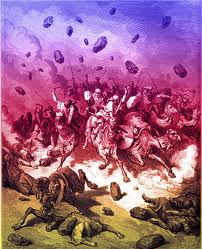
<img class=” wp-image-961″ src=”https://www.biblestudywithrandy.com/wp-content/uploads/2014/09/joshua.png” alt=”An account by Sargon II has similarities to Joshua 10:11” width=”173″ height=”213″ /> An account by Sargon II has similarities to Joshua 10:11

Other insights are provided by a brief discussion of the ancient Near East’s concept of corporate responsibility and how Achan’s sin impacted his whole family, not to mention the entire nation (comment on Josh. 7:1, pp. 218-219). A description of palace architecture also helps the reader better understand Ehud’s assassination of the Moabite king Eglon, and how he managed to escape (comment on Judg. 3:23, pp. 248-249). The authors also frequently quote from ancient texts that have similarities to biblical accounts. For example, one ancient Near Eastern text that comes from Sargon II, king of Assyria “reports that in his campaign against Urartu (714 B.C.) the god Adad stormed against his enemies with ‘stones from heaven’ and so annihilated them” (p. 225). This is reminiscent of the Lord’s intervention for Joshua against the kings of Canaan (Josh. 10:11).

The "witch" at Endor (1 Sam. 28)
The “witch” at Endor (1 Sam. 28)

One very interesting feature relates to an understanding of life after death in the ancient Near East. The authors discuss the strange story of the medium at Endor summoning Samuel at the request of Saul, after Samuel had died (1 Sam. 28). They comment, “This specialist from Endor used a ritual pit to conjure up the spirits of the dead….The pits were believed to be magical portals through which spirits could pass between the realms of the living and the dead. The practitioner was one who had special knowledge of the location of such a pit and who was familiar with the procedures necessary to summon the dead” (comment on 1 Sam. 28:7, p. 318). Of course, this doesn’t mean that the woman conjured up Samuel through her own power, but it does give insight into the ancient beliefs and practices involved. A comment on 1 Kings 16:4 regarding the fate of King Baasha of Israel and his family is also enlightening. The passage states that the king and his family members will be eaten by dogs if they die in the city or by birds if they die in the fields. The authors comment, “most ancient peoples believed that proper, timely burial affected the quality of the afterlife….We know that even Israelites believed that proper burial affected one’s afterlife, because they, like their neighbors, buried their loved ones with the provisions that would serve them in the afterlife; most often pottery vessels (filled with food) and jewelry (to ward off evil), with tools and personal items sometimes added” (p. 373).

IVP Bible Backgrounds Commentary, Old Testament: Limitations

Me hanging out with Philistines at Tel es-Safi (Gath).

The authors frequently site knowledge that is available through archaeology. This could be regarding certain cities, or artefacts. For example, when speaking of the Tabernacle (2 Sam. 6:17, p. 332), the discovery of a Midianite tent shrine that dates from the 12th century B.C. is noted. While this is interesting information, it also points up a shortcoming in the commentary. A photo of such discoveries would be helpful (or a reference where further info and pictures might be found). Additionally, it is the archaeological information contained in the commentary that particularly cries out for a new updated edition. For example, when the Philistine city of Gath is mentioned in the text, the authors constantly remind us that there has been no archaeological work done at this site (see e.g., the comment on 1 Sam. 27:2, p. 317). However, this is no longer the case. In fact, excavations have been going on at Tel es-Safi (biblical Gath) since 1996 with many fascinating discoveries made (see my article on Philistine cities here).

Although the authors have intentionally omitted the use of references for the sake of the average reader, still the lack of references hurt the commentary. Besides the Midianite tent shrine mentioned above, there are many places that references would be extremely helpful, even for the average reader. For example, there is a brief discussion of the problem of the date of the Exodus on page 86. Although the article gives the basic outline of the problems involved, it is still very general. The curious reader, however, is not left with any suggestions on how to pursue a deeper treatment of the subject.

The commentary is also full of repetition. This is not necessarily a bad thing. It can be quite helpful to have information at your fingertips rather than being told to go to another place in the commentary to find it. The problem is the authors do both. For example, whole sections of the commentary on 1&2 Kings refer the reader to 2 Chronicles. Again, if this was the practice throughout the commentary, I would have no problem with it. In fact, it would shorten the commentary considerably and might allow for the photos and references that I believe would be helpful. My complaint is that the decision to repeat information (sometimes 3, 4 or more times), while at other times saying, “see such ‘n such” for information on this passage, seems arbitrary.

Evaluation of Genesis – 2 Kings, IVP Bible Background Commentary

In spite of the shortcomings I have mentioned, I believe this commentary is extremely useful and informative. Besides simply providing a review, I have attempted to show the reader some of the interesting insights available. Other helpful features include geographical information (stating how far it is from one place to another, or what the terrain is like). This can raise important issues for interpretation. For example, what are we to make of the fact that Saul’s hometown is only a short distance away from Samuel’s hometown, and yet Saul had never heard of Samuel! (comments on 1 Sam. 9:6, p. 293). Other helpful explanations include the value of different types of money (shekels, etc.), the times of year represented by the names of various months, and the meaning of certain political or military offices (e.g., the Assyrian official known as Tartan means “field marshal, 2 Kgs. 18:17, p. 405). Although I am hopeful that an update on the Old Testament volume will be forthcoming from IVP (as the New Testament one which appeared this year), I would still heartily recommend this commentary as a source of valuable information in better understanding the Bible and the ancient Near East.

(A copy of this commentary has been provided for the reviewer in exchange for a fair and unbiased review. Many thanks to the publishers at IVP!)

The IVP Bible Backgrounds Commentary: Old Testament is available at ivpress.com, ivpbooks.com, and at Amazon USA / UK


Old Testament Narratives: Paying Attention to Detail

Old Testament Narratives: Paying Attention to Detail

Studying Old Testament narratives

When it comes to reading and studying Old Testament narratives, paying attention to detail really pays off! It is a rare exception when an Old Testament narrator tells the reader something as explicit as, “But the thing that David had done displeased the Lord” (2 Sam. 11:27). More frequently, a biblical narrator will lead us on a journey of discovery. This method is what Old Testament scholars refer to as “showing” rather than “telling.” Revealing a person’s character or proclaiming a particular message by “showing” is certainly a more interesting and artistic approach, but it also makes interpretation more challenging for the reader. Understanding that the biblical author is primarily communicating to us by “showing” should make us alert to the little details that occur in a story. Recognition that writing in the ancient world was an expensive process, and that the Hebrew authors of Old Testament narratives are very succinct in relating an event, makes it even more evident that every word in a story counts.

What to Look For When Studying Old Testament Narratives

So what kind of details should a reader be looking for? It’s impossible in this short article to make an exhaustive list (not that I could anyway), but I will attempt to offer a few suggestions and provide illustrations of the kind of attention to detail I am talking about.

Contrasting Actions

Why Abel's sacrifice is acceptable but not Cain's must certainly be counted among Old Testament narratives that are considered confusing
Among Old Testament narratives that are considered confusing, the difference between Cain and Abel’s sacrifices ranks high on the list.

The story of Cain and Abel’s worship in Genesis 4 often causes confusion for readers. Why does God prefer Abel’s sacrifice to Cain’s? Some have suggested that God prefers a blood sacrifice and thus He rejected Cain’s offering from “the fruit of the ground” (Gen. 4:3). Others say, it is impossible to know. Still others fall back on the words of Hebrews 11:4 which states that Abel’s offering was preferred over Cain’s because he offered it by faith. While this is true, where did the writer of Hebrews get this interpretation of the events? Was it by divine revelation, or is there something in the text that points in this direction? Actually, there is. A careful reading of the story shows that Cain’s offering is much more general, suggesting less care and less devotion to God. Cain is said to offer “an offering,” whereas Abel’s offering is said to be of “the firstborn of his flock and of their fat” (Gen. 4:3-4). In other words, Abel brings his best to God and that is the difference between the offerings. The fact that the same word is used for “offering” for both Cain and Abel (even though an animal offering would normally use a different word), and that God does accept offerings from the ground as acceptable sacrifices (Lev. 2:7-16), further demonstrates that God does not reject Cain’s offering because it is a bloodless sacrifice. The key to the story is in the details of Abel’s offering found in the words “firstborn” and “fat.” Observation of such details ends many debates, solves much confusion, and prevents possible misinterpretations of the story.

Personal Tags

One of the small details often overlooked when reading Old Testament narratives are the tags applied to people’s names. By this I am referring to the little descriptions that follow people such as Abner, the son of Ner, or Uriah, the Hittite. Sometimes these little tags appear to define who a person is or what their relationship is to someone else. However, once their identity is established, there really is no need for the tag. Thus when a tag is constantly used the reader should suspect that there is more to it than simply identifying a person.

Michal peers through the window and despises David (2 Sam. 6:16)

Saul’s daughter Michal is an excellent example of this. Every time Michal appears in the story of 1&2 Samuel, she has a tag applied to her name. When she is first introduced she is called “Saul’s daughter” (1 Sam. 18:20). The next time she appears in the story she is called “David’s wife” (1 Sam. 19:11). Michal’s protection of David in this story suggests that the title “David’s wife” is more than a tag reminding us of her marriage to David. It signifies where her loyalty lies, since Saul is out to kill David. The next two times Michal appears in the story we are told she is “Saul’s daughter” and “David’s wife” (1 Sam. 25:44; 2 Sam. 3:13-14). Since Saul and his family remain at odds with David, these tags suggest a tug of war for Michal’s identity. Which is she, Saul’s daughter or David’s wife? The question is finally answered in Michal’s last appearance in the story. In 2 Samuel 6:16, we are told that Michal (who once upon a time loved David–1 Sam. 18:20, 28), despised David. In this verse, and also in 2 Sam. 6:20-23, she is referred to only as “Saul’s daughter.” This tag suggests that Michal’s affections have come full circle and that she has chosen to identify with her father Saul, rather than with David (for a more in-depth exploration of this idea see my book, “Family Portraits” chapter 10).

Does Anybody Know What Time It Is?

When the time of day is mentioned in Old Testament narratives, it is important!

If a biblical story mentions the time of day, it is usually important. For example, the angels arrive at Sodom in the evening (Gen. 19:1), and by the time the threatening mob gathers it is night time (Gen. 19:5). The destruction of Sodom occurred at sunrise (Gen. 19:23-24) which was considered the time for judging a case in the ancient world. Another example of the use of day and night occurs in the story of Jacob’s wrestling with an angel. The wrestling match happens at night, matching Jacob’s fears and uncertainties as he approaches his brother Esau (Gen. 32:21-22). The wrestling match ends at the break of day (Gen. 32:24, 26), at which time Jacob is blessed and receives a new name. As Jacob limps away from this mysterious encounter we are told that “the sun rose on him” (Gen. 32:31), suggesting that a new day has dawned.  But the writer is not interested in the new day for its own sake. The time notice makes clear that it is a new day for this man who now faces his future, not as Jacob, but as Israel!

What Did You Say?

Jonathan's words to his armor bearer show him to be a man of faith.
Jonathan’s words to his armor bearer show him to be a man of faith.

Since it is rare to get a description or evaluation of a biblical character by the narrator, one of the chief ways of discerning their character is by the words they speak. The first words of a character often provide a guideline for the kind of individual we may expect them to be. For example, Jonathan’s initial words are “Come let us go over to the Philistines’ garrison…” (1 Sam. 14:1). These could either be the words of a reckless individual or a brave individual. After some intervening verses which set the scene, the narrator returns to Jonathan’s opening words and fills out their meaning. Jonathan continues, “It may be that the Lord will work for us. For nothing restrains the Lord from saving by many or by few” (1 Sam. 14:6). These words immediately characterize Jonathan as a man of faith who is not afraid to boldly step out and give the Lord an opportunity to work. By contrast, the first words of Adonijah paint him as an egomaniac. “I, I will be king” (the Hebrew emphasizes the pronoun–1 Kgs. 1:5). So that we don’t miss the significance of Adonijah’s first words, the narrator helps us out by commenting, “Then Adonijah the son of Haggith exalted himself.”

Conclusion — Old Testament Narratives: Paying Attention to Detail

Contrasting actions, personal tags, time of day, and the initial words of a character, are just a few of the many small details found in Old Testament narratives that aid one in biblical interpretation. There are many other things that easily go overlooked, or are taken for granted when reading Scripture. Hopefully this article will encourage each of us to read the Old Testament more carefully, not looking past the obvious clues that the author has placed in the text. One word of caution: We should always allow context to guide us on how important a particular detail might be. In other words, a small detail may contribute to an important insight, but we should not magnify that detail beyond what the text warrants. It is a mistake to make the passage about the detail, rather than to allow the detail to assist us in the interpretation of the passage. The next time you read an Old Testament story, remember to enjoy the details!

Caesarea Maritima

Caesarea Maritima

Caesarea is located on the north western coast.
Caesarea is located on the north western coast. (It can be found left of center in the above picture inside the rectangular box.

Caesarea Maritima, located about 65 miles northwest of Jerusalem on the coast, was one of Herod the Great’s most impressive building accomplishments. The name Caesarea Maritima is used to distinguish it from the well-known Caesarea Philippi, located northeast of the Sea of Galilee. Originally, Caesarea Maritima was the site of an old dilapidated town known as Strato’s Tower, but Herod transformed it between the years of 21 B.C. to 9 B.C. into a magnificent harbor city and renamed it in honor of Caesar Augustus. Before the creation of Caesarea, the area ruled by Herod had no harbour. The only natural harbour in the area was at Haifa, farther to the north and outside of his domain. It is difficult to overstate the enormity of Herod’s accomplishment. “Caesarea was the first artificial harbor constructed in the ancient world” (IVP Dictionary of New Testament Background, p. 176). The success of this man-made harbor depended on the new invention of hydraulic concrete, used for the first time at Caesarea.

Israel Aerial View
The man-made harbor at Caesarea Maritima

Pontius Pilate, Jews and Gentiles at Caesarea

This inscription found in the theatre at Caesarea includes the name of Pontius Pilate

Although Caesarea Maritima had a mixed population, it was created as a gentile city. This is most evident from the Temple to Augustus and Roma that was built “centrally located and adjacent to the inner harbour area” (IVP Dictionary of NT Backgrounds, 176). This means that as a ship sailed into the harbor, the first sight would have been of this imposing temple; no doubt a site that would have inspired a sense of awe in a gentile, while creating a sense of consternation and repulsion to a faithful Jew. This mixture of populations with very different viewpoints would cause constant problems in Caesarea.  Josephus relates one such incident, when after recently arriving as governor of Judea, Pontius Pilate marched his army into Jerusalem with the Roman standards proudly displayed and posted them in front of the Temple. The Roman standards were offensive to the Jews because of the animal imagery they contained. The Romans knew this and normally avoided such a display. Many Jews came to Caesarea and complained to Pilate that the standards be removed. On the sixth day, Pilate stationed his soldiers in the crowd with their weapons hidden. As he sat on the judgment seat and the Jews brought their complaint once again, Pilate had the soldiers draw their swords and threaten the Jews with death. The Jews bared their necks and said they would rather die than allow their law to be profaned. As a result, Pilate backed down (Josephus, Antiquities of the Jews, 18.3.1). Considering this story involving Pilate, it is interesting that Caesarea has yielded the only physical evidence for his existence (Update:  a ring with Pilate’s name has been found. You can read about it here). During archaeological excavations an inscription was uncovered from the theatre dedicating the theatre to the emperor Tiberius, while also mentioning Pilate as the governor of Judea (see the photo above).

Later problems between Jews and Gentiles in Caesarea would result in the slaughter of 20,000 Jews and lead to the outbreak of the Jewish War against Rome. This war, which began in 66 A.D., eventually resulted in the destruction of Jerusalem and the Jewish Temple.

Caesarea: Capital of Roman Judea

Herod's swimming pool at the backside of his palace in Caesarea
Herod’s swimming pool at the backside of his palace in Caesarea

Caesarea became a source of wealth for Herod because it opened up the shipping trade, and thus became a major supply of revenue for his kingdom. Herod built a luxurious palace, including a swimming pool that jutted out into the ocean, the remnants of which can still be seen today. After Herod’s son Archelaus was deposed (6 A.D.), Judea became a Roman province ruled by a governor and the capital was located at Caesarea. Thus Herod’s palace became the residence of the Roman governor, who normally travelled to Jerusalem only during important occasions such as the Jewish feasts (Passover, Pentecost, Tabernacles, etc.) . The city contained many lavish buildings all in the Hellenistic (Greek) style. This included a bathhouse, theatre, various temples and governmental buildings. The city was laid out according to other major Roman cities and included paved streets and sophisticated water and sewer systems.

Just outside of Caesarea are the remants of the ancient aqueduct that Herod built to supply the city with water. The aqueduct stretched 13 miles from Mount Carmel to Caesarea.
A bathhouse in Caesarea.

Caesarea in the New Testament

Caesarea is frequently mentioned in the Book of Acts. Peter was sent by the Lord to share the gospel with a centurion named Cornelius who lived in Caesarea (Acts 10). This event opened the door for the proclamation of the gospel to the Gentiles (Acts 11:18). How interesting that a city known for ethnic struggles between Jews and Gentiles would be the place that God chose to send the Jewish apostle Peter to proclaim the gospel to the Gentile Cornelius! According to the story, Peter had many reservations and had to be convinced by the Lord to go to the house of Cornelius. Could it be that some of the ethnic tension that Caesarea was known for contributed to his hesitation?

It is possible that Philip, known as “The Evangelist” planted the first church in Caesarea. After teaching and baptizing the Ethiopian Eunuch, Philip is said to have preached in many of the cities along the coast, ending up in Caesarea (Acts 8:40). When Paul visited Caesarea later, on his way to Jerusalem, he stayed in Philip’s house where we are also told that Philip had “four virgin daughters who prophesied” (Acts 21:8-9).

The theatre in Caesarea where Herod Agrippa I was struck by God (Acts 12:19-23)
Where Gloria and I are sitting is believed to be the place where kings and governors would have sat in the theatre.

One of the most famous stories in Acts involving the city of Caesarea concerns the very popular monarch, at least among the Jews, Herod Agrippa I (grandson of Herod the Great). Agrippa appeared in the theatre in radiant royal clothing and gave an oration to the crowd. Following his speech the multitudes shouted, “The voice of a god and not of a man!” Because he did not give the glory to God, Herod Agrippa I was struck immediately with a fatal illness (Acts 12:19-23). Josephus’s account corroborates the story in Acts by rendering a very similar version of events.

Looking at the area where Herod's palace was located.
Looking at the area where Herod’s palace was located.
Some believe that this part of the palace (where everyone is standing) is the area where Paul would have appeared for his trial.

Caesarea appears a final time in the Book of Acts as the city of Paul’s imprisonment. After being arrested on the Temple Mount due to false charges of having brought a Gentile with him, Paul was put in prison in Jerusalem (Acts 22:23-30). When a plot was uncovered that certain Jews had planned to kill Paul, he was sent with a Roman escort to Caesarea to appear before the Roman governor, Felix (Acts 23:20-35). Paul ended up staying in prison for 2 years in Caesarea. During that time, he not only appeared before Felix, but also before the new governor, Festus. Festus, who did not understand Jewish law, invited King Herod Agrippa II (son of Herod Agrippa I) to hear Paul’s case (Acts 25-26). Paul’s stay in Caesarea ended when he appealed to Caesar and was sent to Rome.

The Later History of Caesarea

Caesarea continued to grow and expand after the first century. In the time of the emperor Hadrian (117-138 A.D.) a second aqueduct was built. A hippodrome was also built (see photo below). It was one of the larger hippodromes of the Roman empire and could seat over 30,000 people (Interpreter’s Dictionary of the Bible Supplementary Vol., p. 120). Christians continued to live in Caesarea and two of its more famous residents were the great theologian and Bible scholar Origen, and Eusebius who created the first history of the Church. Caesarea continued to thrive until 614 A.D. when it was captured by the Persians. Shortly afterward in 639 A.D. it was destroyed by the Arabs.

Standing on the racecourse of the hippodrome, looking back toward Herod's palace
Standing on the racecourse of the hippodrome, looking back toward Herod’s palace
Looking down at the hippodrome built in the time of the emperor Hadrian.


(All (photos, unless otherwise noted, are the property of Randy & Gloria McCracken and may be used for educational purposes only).