All posts by randymccracken

I am a teacher at Calvary Chapel Bible College York and the author of "Family Portraits: Character Studies in 1 and 2 Samuel".

“You Reap What You Sow”: Violence in the Old Testament Part 6

“You Reap What You Sow”: Violence in the Old Testament Part 6

What-You-Sow-Is-What-You-ReapIn my last article I looked at the nature of God and sin as a reason for the need of judgment (I would encourage you to read or reread that article before continuing, as many of the ideas presented there are important for the discussion here). In this article I will provide a second reason for judgment. The easiest way to sum up this response is with the biblical teaching “You reap what you sow” (e.g., 1 Kgs. 2:32; Hos. 8:7; Gal. 6:8). Although many passages declare that God brings judgment on wicked human beings, the Bible also teaches that sinful people experience the consequences of their own choices, bringing judgment on themselves. Perhaps one of the clearest statements of this principle is found in Psalm 7:14-16: “Behold the wicked brings forth iniquity; Yes, he conceives trouble and brings forth falsehood. He made a pit and dug it out, and has fallen into the ditch which he made. His trouble shall return upon his own head, and his violent dealing shall come down on his own crown” (NKJV).

Proverbs, Esther and the Theme “You Reap What You Sow”

Previously I noted that, since God is the Author and Giver of life, any choice that excludes God is a choice of death. If this logic is pursued, then it becomes clear that we bring judgment on ourselves by making the wrong choices. This idea is stated clearly throughout the Book of Proverbs. One of the best examples concerns the speech of Lady Wisdom in chapter 8. In Proverbs 8, Wisdom claims to have been with the Lord before the creation of the world, as well as present at creation (Prov.. 8:22-31). Everything said in these verses parallels what we previously established about God’s Word (see Part 5 of this series). It is not surprising then when Wisdom states, “For whoever finds me finds life, and obtains favor from the Lord; but he who sins against me wrongs his own soul; all those who hate me love death” (Prov. 8:35-36–italics are mine for emphasis).

Haman hanged on his own gallows. Courtesy of the Digital Image Archive, Pitts Theology Library, Candler School of Theology, Emory University

Stories in the Old Testament frequently illustrate this theme. In fact, some of the acts of violence which are recorded are not acts sanctioned by God, and this violence results in the culprit(s) experiencing the principle: “You reap what you sow.” The story of Haman, recorded in the book of Esther, is an example of this. Haman hated a man named Mordecai, the uncle of Queen Esther, because Mordecai would not bow down before him and show him the proper respect he thought he deserved (Esth. 3:1-6). As a result, Haman planned to have Mordecai hung on the gallows he had constructed, as well as have the Jewish people massacred (Esth. 3:8-15; 5:14). In the end Haman’s plan was uncovered and he was hanged on his own gallows (Esth. 7:4-10).

The Flood and the Theme “You Reap What You Sow”

The Flood resembles the statement in Gen. 1:2

Although the story of the Flood is portrayed in Genesis as God’s judgment on His creation (Gen. 6:7), there is another sense in which humans bring judgment upon themselves. Last time we noticed that Genesis 1 teaches that the Word of God created structure and order out of what was “formlessness and void” (Gen. 1:2) resulting in a good creation (Gen. 1:31). We also noted that sin is a disregard of God’s Word which results in crossing over, or destruction of, the good boundaries He has put in place. The example of a house with walls, doors, and structural beams was used as an analogy to illustrate that order and structure are necessary for a quality existence. To commit sin is similar to knocking out the beams and walls that hold the structure in place. When enough damage is done, the roof caves in. The story of the Flood is told similarly.
Genesis 6:1-6 describes the growth of sin in God’s creation until it is said, “Then the Lord saw that the wickedness of man was great in the earth, and that every intent of the thoughts of his heart was only evil continually” (Gen. 6:5–my emphasis). The description continues in verses 11-12 stating, “The earth also was corrupt before God, and the earth was filled with violence. So God looked upon the earth, and indeed it was corrupt; for all flesh had corrupted their way on the earth” (Gen. 6:11-12). In other words, all of the good order and structure that God had built into His original Creation had eroded away. Instead of the good quality of life that God had created, there was only violence and corruption. As a result of humans kicking out all of the God-given structure that God had put in place, the roof caved in on them and the ground gave way beneath them (Gen. 7:11). If this seems like stretching the language a bit, all one needs to do is check out the language of Genesis 7 (a good modern commentary such as Kenneth A. Mathews, “Genesis 1:-11:26” vol. 1 New American Commentary, p. 376 is also helpful). Genesis 7 purposely recalls the language of Creation in Genesis 1 using similar expressions found there (e.g., Gen. 7:14–”every beast after its kind, all cattle after their kind, every creeping thing that creeps on the earth after its kind, etc. Compare Gen. 1:24-25). The difference is that the language of the Creation story occurs in reverse order in Genesis 7 until the world returns to the formlessness and void of Genesis 1:2. The message is clear: not only has God judged His creation, human beings through their sin, have “reaped what they had sown.”
This message comes through in another way in Genesis 6. After God tells Noah in verses 11-12 that the earth is “filled with violence” and “corrupt,” He pronounces judgment on it by saying in Genesis 6:13, “for the earth is filled with violence through them; and behold I will corrupt (NKJV reads “destroy”) them with the earth.” In other words, God uses the same word to speak of destroying the earth that describes the sin of the people. There are two potential messages here: 1) God’s judgment is fair; Just as people “corrupted” the earth through sin, so He “corrupts” it in judgement; and 2) people have brought judgment down upon themselves. By using the same verb for judgment that describes peoples’ sin, the Bible is declaring, “You reap what you sow.”

When God Takes His Hand Off the Wheel

When God lets go, you reap what you sow!

Another way of looking at this biblical teaching is by saying that God simply takes His hand off of the controls and allows people to experience the consequences of their actions. Again, this is much like a parent who has warned their child to no avail, and finally realizes that they will only learn by experiencing the consequences of their actions. Some will object that the consequences God allows are more severe than what a parent would allow. However, this objection fails to take into account two important factors: 1) the destructive nature of sin (which we established in the previous article leads to death); and 2) the matter of human freewill. Ultimately a parent is helpless if their child exercises free will by destroying their lives with drinking, drugs, or suicide. So it is not true that a parent would not allow their child to experience serious consequences. Sometimes they have no choice! Sin has its consequences and neither a parent or God can prevent those consequences when someone is determined to go in a deadly direction. As we previously established, departure from the God of life, results in death. If God stopped a person from making decisions that led to harmful consequences, then the atheist would complain that God is unfair for not allowing free will. If God allows free will, then He is considered a moral monster for allowing the choices that people freely make to destroy themselves and others. Either way, God cannot win!

Romans 1 and the Theme “You Reap What You Sow”

Romans 1 is an example of the principle we have been talking about. This passage is particularly important for what it teaches about the nature of free will and God’s wrath. In Romans 1:18 Paul’s discussion begins with the statement: “For the wrath of God is revealed from heaven against all ungodliness and unrighteousness of men….” When we hear the words “wrath of God” we immediately expect to read of God sending thunderbolts or other calamities to “let people have it” for disobeying Him. In fact, what Paul says, and this is repeated three times, is that “God gave them over” (Rom. 1:24, 26, 28). In other words, those who don’t want to follow God and insist on going their own way are permitted to do so. This permissiveness of God is an expression of His wrath according to Paul! God simply allows people to do what they want to do and to reap the consequences for their actions. This is then a passive way in which God’s wrath is expressed. God actually does nothing. He takes His hand off and allows us to do what we want. Since what we want has nothing to do with God, the Giver of life, then our choice leads to death (Rom. 1:18-32). This is the same message then that was taught in the Old Testament and once again it can be summed up in the statement: “You reap what you sow.”
Even though this all sounds like bad news, we must not forget the context of grace in which even God’s judgments are set (see Part 4 of this series). The good news is that God has provided a way to escape the power of sin and death (e.g., Rom. 7:24-25). God gives us the freedom to choose, for love must involve freedom of choice. However, the story of Scripture is that whenever people have chosen the path that leads to death, God has always graciously provided a way back to the path of life. That remedy is the free gift of His Son Jesus (Rom. 6:23) and it is received when we repent. Repentance means we turn from the path of death we are on, and turn back to God and the path of life He has illumined for us by His Word.
Near the beginning of this article, I mentioned that a number of the acts of violence spoken of in Scripture are not sanctioned by God. Atheists often refer to such passages claiming that the Bible endorses violence. I will take a closer look at this idea in the next installment of “Violence in the Old Testament.”

Tel-Arad: The Home of Judah’s Other Temple

Tel-Arad: The Home of Judah’s Other Temple

Tel_arad_all
Aerial view of Tel-Arad

Did you know that Solomon’s temple in Jerusalem was not the only temple that existed in Judah during the divided monarchy period? In a discussion of top biblical sites, Tel-Arad is unlikely to make the list with most people. In fact, some of you may be saying, “Tel-what? I’ve never heard of it. Where is it?” This is probably because it is not frequently mentioned in the Old Testament, and it is not connected with any particularly memorable story.  In spite of that, it is a mistake to sell Tel-Arad short as it has some of the most interesting archaeological finds in Israel, including another temple!

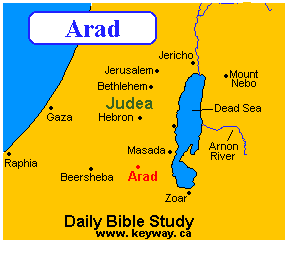
Tel-Arad is 15.5 miles west of the Dead Sea

Tel-Arad is located in the southeastern area of Israel known as the Negev, 22 miles east-northeast of Beersheba and 15.5 miles west of the Dead Sea. Although this area experiences little rainfall, Arad is situated in a strategic geographical location by ancient trade routes coming from the south and southeast. The Canaanites were the original settlers of this area and established a large city here between 3000-2300 B.C. Numbers 21:1-3 says that the King of Arad attacked Israel while they were making their way toward Canaan. The Israelites achieved an overwhelming victory and named the place “Hormah” which means “utter destruction.” Joshua 12:14 also mentions the defeat of a king of Arad. According to Joshua 19:1-8 this area was given to the tribe of Simeon (Arad appears in v. 4 as “Hormah”). Judges 1:16 tells us that the Kenites (the relatives of Moses’ father-in-law) also settled in this area, as did the infamous Amalekites (1 Sam. 27:8-10).

The Fortress at Tel-Arad

The fortress at Tel-Arad

Although there was a small settlement during the time of Solomon, it was during the divided monarchy period that a fortress was established at Tel-Arad. The fortress would have served to protect Judah’s southern border against its enemies, in particular, the Edomites. That this was a dangerous area is evidenced in the fact that the fortress was destroyed 6 times during the divided monarchy period! One of those destructions may have been the result of the great earthquake of 760 B.C. (see Amos 1:1 for a mention of this earthquake).  Three of the destructions of the fortress came during the eighth century B.C. According to the Bible, the Edomites were a constant problem during this time (2 Kgs. 15:7; 16:6). It is likely that one of the destructions of the fortress occurred during Hezekiah of Judah’s rebellion against the Assyrian King Sennacherib in 701 B.C., who is said to have destroyed all the fortified cities of Judah (2 Kgs. 18:13). However, the fortress was rebuilt, but was finally destroyed as a result of Nebuchadnezzar’s conquest of Judah in 586 B.C. Inscriptions from Arad (which we will talk about below) indicate that the Edomites may have been responsible for the destruction, as it is well known that they assisted Babylon at this time (see the Book of Obadiah).

The Temple at Tel-Arad

The temple complex at Tel-Arad. Photo from http://www.bibleplaces.com
The temple complex at Tel-Arad. The altar of sacrifice appears in the center of the picture with the temple in the background on the left. Photo from http://www.bibleplaces.com/arad.htm

Although Bible students are aware of the temples erected in northern Israel by Jeroboam I (see my articles on Tel-Dan), and that Judah continued to have problems with the “high places” (e.g., 2 Kgs. 14:1-4), most, are not aware that Tel-Arad sported a complete temple that included all of the ingredients of Solomon’s temple. I had the opportunity to visit Arad in the summer of 2008 and walk through this temple complex. Since it is not possible to excavate the ruins of Solomon’s (or Herod’s) temple, it is fascinating to get a first hand view of what an ancient Israelite temple looked like. The altar of burnt offering in the courtyard is made of unhewn stones and follows the specifications laid down in Exodus 27:1. The temple itself consists of two rooms, as described in Scripture. The first, (the holy place) is a broad room resembling the same layout as Jeroboam’s temple in Tel-Dan. In contrast, the holy place in Solomon’s temple consisted of a long room. After entering the broad room one can then approach and enter a square room which would have been the holy of holies. It was fascinating to stand in this room and think about what would have taken place here. Who would have entered this room and when? Since there was no Ark of the Covenant here, what was done in this room? Was the Day of Atonement ritual practiced here? Did the high priest come down from Jerusalem, or did another appointed priest have access to the holy of holies in Arad? Many questions, but not many answers!

This is a close-up of the altar of sacrifice at Tel-Arad with our friend Lilah pretending to be a living sacrifice (Rom. 12:1-2)!

There are a couple of other fascinating things about entering the holy of holies at Tel-Arad. One is the altars of incense placed on either side of the entrance, and the other is the two “standing stones” (masseboth in Hebrew) inside. These stones (which I am crouching between in the photo below) supposedly represent Yahweh and his Asherah, or wife! This is an excellent example of the corruption of true Yahweh worship and why the Scripture insists that God was only to be worshipped at the place which He chose (Deut. 12:1-8). This sanctuary was covered over before Sennacherib’s destruction in 701 B.C. and never reused. It is thought that this is probably due to the reforms of King Hezekiah mentioned in 2 Kings 18:1-6. (For another recent discovery of a Judean Temple at Tel Motza, see my post Five Recent Archaeological Discoveries.)

Me in the holy of holies at Tel-Arad sitting between the 2 standing stones representing Yahweh and his Asherah

The Tel-Arad Ostraca

One of the Arad ostraca discovered at Tel-Arad
One of the Arad ostraca discovered at Tel-Arad. Photo from Mnamon Ancient Writing Systems

Ostraca are pieces of broken pottery that were often used in ancient times as writing material. Archaeologists have discovered 88 Hebrew ostraca at Tel-Arad. This is an amazingly large quantity and, along with the temple complex, is evidence that Arad was a regional administrative and perhaps religious center. Among the 88 pieces, 15 are whole. The inscriptions date from the eighth to sixth centuries B.C., with the possibility of some being as old as the tenth century B.C. No other archaeological site has ever yielded ostraca that date from different periods in Israelite history. These ostraca not only provide insight into various stages of Judah’s history, but they help biblical scholars note the development and change of the ancient Hebrew language. A few of the ostraca mention the Edomites as enemies. It is this evidence that suggests the Edomites played an important part in the final destruction of Arad. Another ostracon (sg.) seems to be a “royal” inscription. It only exists in part, but it appears to be a letter from the king of Judah announcing his accession to the throne, with a reference to the “King of Egypt” as well. If this is correct, then this letter may be from Judah’s new king Jehoahaz who became king after the Pharaoh of Egypt (Necho II) killed his father Josiah at the battle of Megiddo in 609 B.C. (2 Kgs. 23:31). Another important ostracon mentions a priestly family (the family of Keros) who are referred to in Ezra 2:44 and Nehemiah 7:47. This same ostracon mentions “the house of Yahweh” which is the only nonbiblical reference to any preexilic temple to Yahweh (unless it is one day proven that the Jehoash inscription is authentic–for more info see the following link at bibleplaces.com). Tel-Arad is indeed a fascinating site with a lot to offer those who are interested in the history of ancient Israel. Ask your tour guide to add it to your itinerary the next time you go to Israel! For more information on ancient Arad, and examples of translations of some of the ostraca go to the following link: jewishvirtuallibrary.

All photos, unless otherwise indicated, are the property of Randy & Gloria McCracken and are only to be used for educational purposes.

Note: Some of the information from this article was taken from Dictionary of the Old Testament Historical Books, eds. Bill T. Arnold & H. G. M. Williamson (Downers Grove: IVP, 2005), pp. 39-41, 372-373. You can order a copy of this dictionary at:

Amazon USA / UK51o-OY-pC3L._SY445_

The Necessity of Judgment: Violence in the Old Testament Part 5

The Necessity of Judgment: Violence in the Old Testament Part 5

Why does God judge?
Why is God’s judgment necessary?

In our last article I looked at the context of grace which surrounds stories of judgment such as the Conquest of Canaan. I ended the article with the following observation and questions: “Some will object and say that it is unreasonable for God to bring judgment on people who don’t want to follow Him. Why must they receive judgment? Why can’t God just ‘live and let live?'” To these questions I will add one other, “If the God of the Bible is so gracious why does He have to judge anyone?”

I want to explore three responses to this question. In this article we will look at two responses and follow up with a third response in the next article. The first two responses require that we look at what the Bible reveals about the nature of God and the nature of sin. Therefore we will examine these ideas first to lay the groundwork, and then move to the topic of God’s judgment.

God is Pro-Life

edenThe Old Testament opens in Genesis 1 with the story of Creation. This story affirms that God is the Author of all life. Out of the darkness and void of Genesis 1:2, God brings everything into existence. According to Genesis 1, God doesn’t skimp on any of the details for His Creation. By the time He is finished Genesis 1:31 tells us “Then God saw everything that He had made, and indeed it was very good.” The word “God” is used 35 times in the Creation story, which extends from Genesis 1:1-2:3. He is the only subject of the Creation story. This means that Creation and the giving of life is God’s idea and is brought into existence by His power alone. The Creation story teaches that God is the source of all life. We could say without any exaggeration that the Creation story teaches that God is “pro-life.”
exodus-3-14God’s personal name Yahweh is introduced in Genesis 2:4 (written as “the LORD” in English versions of the Bible). God’s personal name comes from the Hebrew word for “being.” When God reveals His name to Moses He defines Himself as, “I AM WHO I AM” (Exod. 3:14). Actually, the meaning of God’s name can be translated in several ways, but the important point is that God’s name points to His eternal nature. He is the self-existent One. He is Life and Being and in need of no one or nothing for His existence. Revelation 4:8 describes Him as the One “Who was and is and is to come!” The New Testament reveals the same truth about Jesus. John begins his gospel with the words, “In Him was life, and the life was the light of men” (John 1:4). Jesus says, “I have come that they may have life, and that they may have it abundantly” (John 10:10). This sounds very similar to the declaration of Genesis 1:31. Notice, that it has always been God’s intention to give His Creation life and to give it abundantly. God is not stingy when it comes to the gift of life! Further on in the Gospel of John Jesus says, “I am the resurrection and the life. He who believes in Me, though he may die, he shall live” (John 11:25). Again Jesus declares to His disciples, “I am the way, the truth, and the life” (John 14:6). Clearly the Bible goes overboard to make this point: God is life. In His very essence He is life, He is the Giver of life, and His desire is to give life abundantly.
life-giverRecognition of this biblical truth is important for several reasons. First, if God is life and the Giver of life, then it follows that rejection of God is a choice that leads to death. A person cannot say “I want life, but I don’t want God.” It’s simply not an option. In rejecting God, a person is rejecting life itself and so, biblically speaking, it becomes an oxymoron to say “I want life, but I don’t want God.” Moses made this clear to the children of Israel long ago when he said, “…I have set before you life and death, blessing and cursing; therefore choose life, that both you and your descendants may live; that you may love the Lord your God, that you may obey His voice, and that you may cling to Him, for He is your life and the length of your days…” (Deut. 30:19-20). Not only does this passage state that choosing God is choosing life and blessing, it infers not to choose Him is death and cursing. Furthermore, notice that the exhortation is “choose life.” God’s desire is that we choose life. In my last article we noted the passage from Ezekiel where God says, “‘For I have no pleasure in the death of one who dies,’ says the Lord God. ‘Therefore turn and live!'” (Ezek. 18:32). The Bible could not be any clearer that God desires life for His Creation.

Sin’s Opposition to the Life-Giving Word

Bible-Verse-In-The-Beginning-Genesis-1-1-3-Let-There-Be-Light-HD-WallpaperGenesis 3 teaches that sin is a disruptive force in God’s good Creation. To understand this more completely, we need to return to Genesis 1 and examine the part that God’s Word plays in Creation. Genesis 1 teaches that God brought everything into existence by His Word. “Then God said…” is always the start of God’s creative acts (e.g., Gen. 1:3, 6, 9, 11, etc.). This is why the Psalmist (Ps. 33:6), the apostle John (John 1:1-2), and the writer of Hebrews (Heb. 11:3), all insist that the world was created by the Word of God. Therefore Genesis 1 teaches us that the Word gives life. The Word is the agent through which all life comes into being. What does this Word do? It takes the “formlessness and void” of Genesis 1:2 and begins to construct a world in which life can flourish. The Word does this by bringing order out of chaos. The Word takes formlessness and creates structure, and fills the empty void with life and life-giving substances.

God divides the light from the darkness

One of the ways the Word accomplishes this is through the process of “dividing.” We are told that God “divides” the light from the darkness (Gen. 1:4), the waters above the heavens from the waters below (Gen. 1:6-7), and the day from the night in order to create seasons (Gen. 1:14, 18). We are also told that, by His Word, God gathers the waters together so that dry land can appear (Gen. 1:9-10). Another way in which God, through His Word, brings order out of chaos is by bringing forth trees, fruit, and animals “according to their kind” (an expression which occurs 10 times in Genesis 1). The point of all this is to declare that the Word brings life by creating order and structure from the chaos.

Sin’s Destructive Nature

A house needs structure!

We can all appreciate this. If we are looking for a house to live in we don’t want a pile of rubble. We need structure. We want walls, doors, ceilings and windows. We want plumbing and electricity to be in its proper place. Genesis 1 teaches us that the Word of God is good because it brings order and structure into being and creates life out of what was once an uninhabitable place. The reason sin is so dangerous, according to the Bible, is that it is a crossing-over, or destruction of the good boundaries that God’s Word has set in place. It is not accidental that when the serpent tempts Eve, he begins with, “Has God indeed said…” (Gen. 3:1). In other words, the serpent attempts to get Eve to mistrust God’s Word. If Eve oversteps the boundaries put in place by the Word, then she steps into a dangerous world. God had warned Adam concerning the forbidden fruit, “In the day you eat of it you shall surely die” (Gen. 2:17). This statement is not a threat, “You better do what I tell you or else!,” it is a warning by the Lord of life. God knows that to step outside the protective boundaries He has set up, boundaries necessary to hold back the chaos (Gen. 1:2) and produce an abundant life (Gen. 1:31), is to step into a world of death. homewreckerThis is similar to walking into a beautiful home and one by one knocking out the support beams and walls because they seem too restrictive. Knock out enough supports, or a key support, and the whole house will fall in on our head. To enter the world of sin is to leave the safety and protection of the Lord of life behind and to enter a world where only death exists. This is so because anything apart from God (the source of all life), is death. Therefore to choose against God and against his Word is to choose death.

Live and Let Die

This is why it is impossible for God to take a “live and let live” attitude toward those who rebel against Him. The simple fact is, there is no life apart from God. The best that God can do for a person who constantly refuses Him is to have a “live and let die” attitude! Thank heaven that God cares too much to simply leave it at that without trying everything possible to turn His Creation back to Him.

Reasons for God’s Judgment

There are basically two reasons then for God’s judgment of the rebellious unbeliever. First, God desperately wants to give life to all of His Creation. Therefore He warns (and even sends) judgment in hopes that people will repent and come to life. We saw this principle in our last article as noted in Jeremiah 18:6-10 and the example of the Ninevites repentance in the book of Jonah. parentThis is similar to the parent who warns a child of harm or punishment if they don’t stop doing such ‘n such. Is the parent cruel? Is the parent trying to spoil the child’s fun? We know better. We can easily see that the parent acts in the child’s best interest so that the child can have a happy productive life. The parent’s warning is motivated by love. Better to be threatened with punishment, or even experience punishment, than to experience the consequences of something worse. Why do atheists find it so difficult to grasp this principle of God’s character when they would respond similarly toward the child they love?

Charles Manson
Charles Manson

The second reason for God’s judgment is that there are some who will never accept God and His correction and, therefore, for the good of His Creation they must be dealt with. This is similar to having a dangerous individual in our society who refuses to change. Perhaps they are a thief, a murderer, or a child-abuser. How long should we tolerate the behavior of a person who refuses to change but is a danger to society? At some point judgment must occur. No one wants to live in a society where there is no justice. God is incredibly long-suffering (even more so than us!), but God will not let sin go unchecked forever. In God’s judgment, He not only hopes for the repentance of the sinner, He seeks to protect the rest of His Creation from a destructive person (or people) who refuses to change and thus endangers everyone else.
Some will object by saying that God’s judgment seems much harsher than a parent’s punishment. I will deal with this idea more in a future article, but here I will note that this response doesn’t understand the gravity of sin. As we have seen, sin leads to death because it turns its back on the One who gives life. As the apostle Paul wrote, “the wages of sin is death” (Rom. 6:23). If God does not judge sin, then sin runs rampant over His Creation and death is the ultimate victor. But, as we have seen, God’s desire is to give life to His Creation. Thus Paul’s statement in Romans 6:23 does not end with the bad news of death; it continues, “but the gift of God is eternal life in Christ Jesus our Lord” (Rom. 6:23).Romans6_23
In my next article I will examine a third response concerning the biblical teaching on judgment.

Typology: A Key to Interpreting the Bible

Typology: A Key to Interpreting the Bible

In this article we will talk about the importance of typology and what it means

Did you know that one way in which the biblical authors sought to communicate God’s truth was by comparing and contrasting various characters and situations? This may seem obvious to a regular Bible-reader, but people are often surprised how frequently this occurs in Scripture and how helpful it can be in interpreting the Bible. This practice has come to be known as “typology” from the Greek word typos.

Jesus' use of typology
Jesus’ use of typology

“Typology means that earlier characters and events are understood as figures of later characters and events, and the text is written in a way that brings out the connection” (Peter Leithart, “A Son to Me: An Exposition of 1&2 Samuel,” p. 13).

Where Does the Practice of Typology Come From?

Peter uses typology when he compares Noah's flood to baptism
Peter uses typology when he compares Noah’s flood to baptism

The Greek word means “pattern” or “example.” It is used 14 times in the New Testament (e.g., Acts 7:44; Phil. 3:17; 1 Tim. 4:12; Heb. 8:5). Most important for our purpose is that Paul and Peter use examples from the past as a way of paralleling or contrasting current situations of their day. In 1 Corinthians 10:6 Paul uses the word typos to warn the Corinthian believers not to imitate the Israelites in the wilderness (see also 1 Cor. 10:11). 1 Peter 3:20-21 calls baptism an “antitype,” corresponding to the waters which saved Noah and his family. These passages form the basis for what has become known as a “typological” approach or interpretation.

Old Testament authors often employed a similar approach to that of Paul and Peter although the word typos (or its Hebrew equivalent) was not used. In fact, there can be little doubt that Paul and Peter learned this method from their Old Testament counterparts. Have you ever read a story in the Old Testament and thought, “That reminds me of another story I read in the Bible”? There is a reason for that! Biblical authors intentionally recall earlier stories, characters, and events as a way of commenting on the story, character, or event they are relating. The student of the Bible is being invited to compare the stories or characters in order to notice these similarities and differences. Through this comparison, the reader gains insight into what the biblical author is communicating. This is especially helpful when one is trying to understand a particular biblical character. The reader should not only look to the immediate context to understand a character (or event), but also the wider context of Scripture where echos of the present story occur.

Typology in the Story of Abigail

Abigail intercedes before David

The author(s) of 1&2 Samuel was a master of this technique, and as a way of illustrating my point I am using a small excerpt from my book “Family Portraits (USA link).” Abigail is introduced to the reader in 1 Samuel 25. Although the story provides a lot of information in forming a character portrait of Abigail, typology is also very helpful. In fact, it’s amazing how many characters in the Old Testament can be called upon to help us in constructing a portrait of Abigail. However, I will only focus on one example. One way in which the character of Abigail is enhanced is by noting the similarities she shares with Hannah (and vice versa).

The following is an excerpt from my book “Family Portraits (UK link)” in the chapter entitled, “Abigail: The Peacemaker” (pp. 226-227):

One of the greatest connections, as far as the books of Samuel are concerned, is between Abigail and Hannah….First, both Hannah and Abigail find themselves in desperate situations. Although these situations are different, the future of a household is at stake in each case. Second, both women make supplication to a superior, using the term “maidservant” to describe themselves (1 Sam. 1:11; 25:24ff.). Third, in making their supplications both ask to be “remembered” (1 Sam. 1:11; 25:31). Fourth, Hannah makes a vow (1 Sam. 1:11), while Abigail swears an oath (1 Sam. 25:26). Fifth, the Lord causes Hannah’s face to be sad no longer (1 Sam. 1:18), while David lifts up Abigail’s face (1 Sam. 25:35). Sixth, both share the theme of “strength through weakness” because of their dependence on the Lord. Seventh, words from Hannah’s prayer are reflected in the story of Abigail and Nabal. Abigail assumes a lowly position and is lifted up (1 Sam. 2:7; 25:23–24, 35), while arrogance proceeds from Nabal’s mouth (1 Sam. 2:3; 25:10–11) resulting in the Lord striking him (1 Sam. 2:6; 25:38). Eighth, and perhaps most important, both adopt a prophetic role that has significance for the future kingship (1 Sam. 2:1–10; 25:26, 28–31). It was Hannah who first proclaimed, “He will give strength to His king and exalt the horn of His anointed” (2:10); and it was Abigail who first announced the “sure house” that the Lord would give to David. The books of Samuel testify that these women were the first to foresee and utter these great truths, which would change the course of Israel’s history. The stories of Hannah and Abigail thus highlight the important role that women played in inaugurating the monarchy. Although Israel, like the nations around it, was a patriarchal society, clearly Israel’s God “shows no partiality” (Acts 11:34).

Typology: Letting Scripture Interpret Scripture

Typology allows Scripture to interpret Scripture

Hopefully this brief example demonstrates the value of comparing biblical stories with similar themes or characters. By comparing Hannah and Abigail, we come to know them both better and we see the common themes being emphasized in their stories. This, in turn, helps us to better understand the message of 1&2 Samuel. The use of typology also allows us to interpret Scripture with Scripture. Although we always approach the text with a certain amount of subjectivity (our background, presuppositions, church tradition, etc.), the similarities (or contrasts) made between Bible characters or events through the use of typology, helps us to better hear the message(s) that the inspired author intended us to hear.

The Context of Grace: Violence in the Old Testament Part 4

The Context of Grace: Violence in the Old Testament Part 4

In my last article on Violence in the Old Testament, I noted that atheists ignore the context in which the stories of violence occur. This context is a context of grace. In particular we looked at the Conquest of Canaan, a bone of contention with nonbelievers, and we surveyed the immediate context of the Conquest found in the books of Deuteronomy and Joshua and offered some responses for those who claim the Conquest is evidence of a genocidal, xenophobic god. In this article we will widen our scope by looking at the beginning of the Conquest story which has its roots in God’s promise to give Abram the Land of Canaan.

Genesis and the Context of Grace

Call of Abram
Call of Abram

The story of God’s promise to give Abram the Land of Canaan is birthed in a context of grace. According to Genesis 12:1, God calls Abram to go “to a land that I will show you,” and proceeds to make 7 promises to him (Gen. 12:2-3). These promises are underscored by one of the keywords of Genesis: “bless.” In fact some form of the word “bless” occurs 5 times in these two verses. God’s purpose in calling Abram is summed up by the well-known promise, “And in you all the families of the earth shall be blessed.” Notice that this promise does not exclude the Canaanites. The promise is not “all the families of the earth” except the Canaanites! Abram and his descendants are God’s chosen vessel(s) to bring blessing to every nation. In Genesis 13:14-17, God specifically promises Abram the Land of Canaan. This promise is reiterated in Genesis 15:18-21, clearly marking out the land and peoples involved.
The obvious question is, “Perhaps this context of grace is good news for the later Israelites, or other nations, but how can the promise to give Abram and his descendants the Land of Canaan be good news for the Canaanites?” I will seek to answer this below, but before doing so, there is another important detail that needs our attention. A few verses earlier in Genesis 15 God tells Abram that neither he nor his descendants will possess Canaan immediately. In fact 400 years will pass before Canaan becomes the possession of Abram’s descendants (15:13-16)!

Election Involves Rejection

"Your descendants will be strangers in a land that is not theirs and will serve them" (Gen. 15:13)
“Your descendants will be strangers in a land that is not theirs and will serve them” (Gen. 15:13)

There are three aspects of this declaration that are important for us to consider. First is the shocking revelation that Abram’s descendants will suffer affliction and slavery in a foreign land. I doubt that this sounded like “good news” to Abram. An important biblical truth evidenced here and seen throughout Scripture is that election involves rejection. Atheists misunderstand the biblical concept of election (and so do some Christians). They accuse the God of the Old Testament of being arbitrary and showing favoritism. God’s election is likened to the negative human fallibility of favoring certain people over others due to racial prejudice or some other superficial standard. God’s choices are considered fickle and capricious. Once again, this is to remove the idea of election from its context of grace. As Genesis 12:1-3 demonstrates, God chooses some in order to bless all. Furthermore, God’s chosen are not exempt from hardship, but often endure misunderstanding and rejection. Strangely, it is through the suffering of the elect, that God not only redeems them, but others. Joseph is one example in the Old Testament (among many others), while Jesus is the supreme example of this truth (the suffering Servant of Isaiah 53). Receiving the Land of Canaan then will not be an easy journey for Abram or his descendants.

Grace Waits!

Abram builds and altar

Second, neither Abram or his descendants will be given the land immediately. God says there will be a 400 year waiting period! This waiting period demonstrates God’s justice and recognition that the land currently belongs to the Canaanites. He will not dispossess them without providing examples of how they should live, and warnings of coming judgment. The patriarchs, although far from perfect, become a living sermon to the Canaanites of the power and faithfulness of the God of Abram, as well as setting an example of worshipping the true God. Abram constantly sets up altars to the true God wherever he goes (e.g., Gen. 12:7, 8) and worships Him publicly (this is the meaning of the expression to “call on the name of the Lord” – e.g., Gen. 13:4). This same example is followed by Isaac (Gen. 26:25) and Jacob (Gen. 35:2-3, 7). Furthermore, God’s blessing on the patriarchs, as well as His protection of them (even when they don’t deserve it!), provides evidence that He is the true God and faithfully keeps His promises (Gen. 14:19-20; 21:22-23; 26:28-29; 31:29, 42; 35:6).
ten plaguesGod’s judgments are also intended to turn people from idolatry to worship of Himself. This is not only true in the book of Genesis, it is the major reason behind the ten plagues in Egypt (along with freeing the Israelites). The constant refrain found in the plague narrative is “then you/they will know that I am the Lord (Exod. 6:7; 7:5; 8:10, 22; 9:14, 16, 29; 10:2). Through the plagues all the false gods of Egypt are revealed for what they really are, and even Pharaoh’s court magicians realize the power of God (Exod. 8:19). The judgments were necessary because people do not easily give up well-entrenched beliefs and practices even if they are false. A visible demonstration of the power of the true God was actually a gracious revelation. It was the only way to break through centuries of false worship and belief and, according to Exodus 11:3, it made an impact on the people of Egypt. Furthermore, the plagues on Egypt and the crossing of the Red Sea became another witness to Canaan and the surrounding nations that Israel’s God was the true God (Exod. 15:14-15). These events not only brought fear on the Canaanites, but as we saw last week, led to the repentance of some and the worship of the true God (Josh. 2:10-11; 9:24). Centuries later even the Philistines would recall these events and realize the power of Israel’s God (1 Sam. 4:7-8; 6:5-6). This brief survey clearly shows that the Canaanites had ample positive and negative witness for believing in Israel’s God. Therefore, when the Conquest began, they had been given plenty of time and witness.

The Context of Grace Involves Announcing Judgment in Advance

Third, the statement, “For the iniquity of the Amorites is not yet complete” (Gen. 15:16), reveals the patience and mercy of God which is attested elsewhere in Scripture. The statement reveals that the Canaanites (referred to hear as “Amorites”) were already a wicked people. Yet in spite of that, God was not willing to simply hand over the land to Abram. God would wait. Although this statement is a warning of impending judgment, it is also a statement of amazing grace and reveals a consistent quality of God’s character evidenced throughout the Bible. The point I want to emphasize here is that God always announces judgment in advance and allows the opportunity for repentance. This characteristic is not evidence for the bullying, capricious god that the atheists like to portray, but rather of a patient God who would rather see repentance than destruction.

Jonah knew the context of grace and he was none to happy about it!

God’s statement in Genesis 15:16 has similarities with the words he sends Jonah to proclaim to the Ninevites: “Yet forty days, and Nineveh shall be overthrown!” (Jonah 3:4). This statement sounds like judgment is inevitable but notice two things. First, God allots a certain period of time before judgement will fall. He does not bring it unannounced. Second, as the book reveals, the reason God waits is in hope that the people will respond in repentance, which they do! (Jonah 3:6-9). As a result, God reverses His decision to judge and shows mercy (Jonah 3:10). We learn in Jonah chapter 4 that this was the real reason Jonah didn’t want to go to Nineveh. He knew how gracious God was and he quotes the words revealed to Moses long ago about God’s merciful nature (Jonah 4:2; see Exod. 34:6). The problem with Jonah was that, unlike God, he was prejudice and he wanted this hated enemy of Israel destroyed. Therefore, he didn’t want to preach a word of judgment to them because he didn’t want them to have the opportunity to repent and be saved from destruction! This story clearly illustrates the same point as the Conquest of Canaan. God does not judge people because of prejudice, but because of sin. “The iniquity of the Amorites is not yet complete” demonstrates that God’s judgment has nothing to do with ethnicity (as I established in the last article) but with sin. God’s reason for waiting 40 days or 400 years is for the purpose of giving people an opportunity to change and repent. The Canaanites who did repent (like Rahab) were saved, those who didn’t experienced a judgment that was long overdue.

A Look at the Wider Context of Grace

The potter's wheel
Jeremiah at the potter’s shop (Jer. 18:1-10)


This same truth is emphasized in two other prophetic texts that are important to mention. In Ezekiel 18:30-32 God pleads with Israel and says, “‘Therefore I will judge you, O house of Israel, everyone according to his ways,’ says the Lord God. ‘Repent and turn from all your transgressions, so that iniquity will not be your ruin.'” God concludes by telling Israel He finds no pleasure in anyone’s death, but desires repentance so that they might live. Notice that, although the Lord proclaims judgment, it’s repentance that He really desires. The prophet Jeremiah relates this same principle and he does it in a way that reminds us of the story of Jonah. In Jeremiah 18 the prophet visits the house of a potter and learns an important lesson from the Lord. The verses that particularly concern us here are Jeremiah 18:6-10. God tells Jeremiah that when He speaks a word of judgment, if that nation repents He will “relent of the disaster” that He thought to bring upon it (Jer. 18:8). Similarly, if God speaks a word of blessing on a nation but the people turn from Him, He will relent concerning that word of blessing (Jer. 18:10). The New Testament also confirms that God delays judgment in hopes that people will repent. 2 Peter 3:9 states, “For the Lord is not slack concerning His promise, as some count slackness, but is longsuffering toward us, not willing that any should perish but that all should come to repentance.” The Bible reveals a remarkable consistency in testifying to the redemptive nature behind God’s announcement and execution of judgment. Therefore the new atheists and other skeptics do a great injustice to the biblical message when they ignore the context of grace in which these words of judgment occur.
In conclusion, to be true to the biblical account, it is important to maintain the context of grace. At the heart of God’s selection of Abram (Abraham) and Israel is a desire to bless all nations. Through the positive example of worship of the true God and revelation of His will (by His Word), God seeks to draw all people to Himself. Warning of judgment, as well as the execution of judgment, is necessary when people refuse God’s gracious invitation by continuing in their sin. This is why even the Conquest of Canaan was both good news and bad news for the Canaanites. It was good news for people like Rahab, Uriah the Hittite (2 Sam. 11 – whose name means, “Yahweh is my light”), and Araunah the Jebusite (2 Sam. 24), foreigners who served the living God and were incorporated into the people of Israel. But it was bad news for those who hardened their hearts and continued in their rebellious ways. Some will object and say that it is unreasonable for God to bring judgment on people who don’t want to follow Him. Why must they receive judgment? Why can’t God just “live and let live?” We will examine these questions in our next article on Violence in the Old Testament.