All posts by randymccracken

I am a teacher at Calvary Chapel Bible College York and the author of "Family Portraits: Character Studies in 1 and 2 Samuel".

Jephthah’s Vow (Part 1): What Did Jephthah Do to His Daughter?

Jephthah’s Vow (Part 1): What Did Jephthah Do to His Daughter?

Ehud before the Moabite King Eglon. I opted for a less violent depiction of their encounter!

The Book of Judges frequently gets a lot of negative press. Stories like the gang rape of a concubine (Judg. 19:25-30), and graphic descriptions of an overweight king having a dagger plunged into his belly (Judg. 3:21-25), or an enemy general having a tent peg driven through his skull (Judg. 4:21; 5:26-27), make many people, understandably, uneasy. Jephthah’s vow concerning his only daughter seems to be another example of the barbarity described in this book (Judg. 11:30-40). But is it? What exactly did Jephthah vow, and what did he do to his daughter? There are two proposed interpretations:

  1. Jephthah offered up his daughter as a whole burnt offering.
  2. Jephthah devoted his daughter to the sanctuary of the Lord as a perpetual virgin, or secluded her away with no hope of marrying and bearing children.

It should be noted at the outset that proponents of both of these views are genuinely seeking to understand and communicate the message of the text. While a majority of commentators opt for proposal number 1 above, there are some who ardently argue for the second proposal. It is suggested that some of the Judges, in particular, Jephthah and Samson, have received a bad rap by recent commentators. I have blogged about an example of this in my article: Samson and the Gaza Prostitute: Did He or Didn’t He?. Scholars such as Gordon P. Hugenberger, Miles Van Pelt, and Rikk Watts, argue for a more positive understanding of Samson, and the role played by the judges in the Book of Judges. One can also find various blogs on the internet defending, what some consider, the questionable actions of Jephthah and Samson (e.g., Miles Van Pelt’s article: What was Samson Doing with a Prostitute in Gaza? at thegospelcoalition.org.; or David Murray’s article: Jephthah’s Perfect Vow at headhearthand.org).

I have no illusions of solving the controversy that has raged over this passage for many centuries, but having studied and taught the Book of Judges for a number of years, my desire is to provide a response to those who look more positively on Jephthah’s vow and actions (proposal number 2 above). So the cat is out of the bag! I am among those who understand Jephthah’s vow and actions as comforming to the first proposal. Based on the language and context, I firmly believe that Jephthah did, misguidedly, offer his daughter up as a whole burnt offering. In this post, I will look at what I perceive to be the weaknesses of proposal 2. I will then follow up with another post suggesting the strengths of proposal 1.

Jephthah’s Vow: Weaknesses of Proposal 2

  1. The daughter of Jephthah willingly submitted to her father's vow.
    The daughter of Jephthah willingly submitted to her father’s vow.

    I will begin with what I believe to be one of the greatest weaknesses of the proposal that Jephthah did not offer his daughter as a burnt offering. Ancient testimony is uniform (both rabbinic and church fathers) in understanding that Jephthah did indeed offer his daughter as a burnt sacrifice. It was only in the Middle Ages that an alternative was first suggested by the respected rabbi, David Kimchi (1160-1235 AD). The following lengthy quote is taken from Keil and Delitzsch’s Old Testament commentary on Judges:”With regard to Jephthah’s vow, the view expressed so distinctly by Josephus and the Chaldee was the one which generally prevailed in the earlier times among both Rabbins and fathers of the church, viz., that Jephthah put his daughter to death and burned her upon the altar as a bleeding sacrifice to Jehovah. It was not till the middle ages that Mos. and Dav. Kimchi and certain other Rabbins endeavoured to establish the view, that Jephthah merely dedicated his daughter to the service of the sanctuary of Jehovah in a lifelong virginity” (Keil, C. F., & Delitzsch, F., 1996, Commentary on the Old Testament, Vol. 2, p. 280).

  2. The argument I consider the strongest for proposal 2 suggests that the Hebrew conjunction (waw) can be translated as “or” rather than “and” in Jephthah’s vow. Here then are the 2 possible ways of translating Jephthah’s vow in Judges 11:31: a. “Whatever comes out of my house to meet me…shall surely be the Lord’s and I will offer it up as a burnt offering”; or, b.  “Whatever comes out of my house to meet me…shall surely be the Lord’s or I will offer it up as a burnt offering.” The biggest problem with accepting the translation “or” instead of “and” is related to the previous argument above. No one in the ancient world (who arguably knew ancient Hebrew better than we do) understood Jephthah to be saying “or.” Furthermore, Trent Butler points out that Jephthah’s vow has 2 presuppositions: 1) God will give Ammon into Jephthah’s hand; and 2) Jephthah will return in peace. Butler then comments, “To the two presuppositions are attached two promises: whatever comes from Jephthah’s house to meet him will be given ‘to Yahweh,’ and such gift will be given by means of a burnt offering” (Trent C. Butler, Judges, Word Biblical Commentary, Vol. 8, p. 287). Therefore, the translation “and” makes more linguistic sense as it shows how the 2 promises made by Jephthah fit the 2 presuppositions he requests from the Lord.
  3. Those who advocate proposal 2 note that when Jephthah’s daughter asks for 2 months, it is in regard to weeping for her virginity (Judg. 11:37), not weeping because she will be put to death. This argument, however, overlooks the fact that one of the greatest tragedies in the ancient world was not death itself, but the inability to have chidren, and even more so, the extinction of the family line. Thus mourning her virginity is an understandable response. Furthermore, long ago Matthew Henry had one of the greatest rebuttals for this argument when he stated, “Besides, had she only been confined to a single life, she needed not to have desired these two months to bewail it in: she had her whole life before her to do that, if she saw cause” (quoted in Dale Ralph Davis, Judges: Such a Great Salvation, p. 147).
  4. It is sometimes argued that Jephthah had the Spirit and therefore he would not have made such an ungodly vow. This statement is clearly incorrect, as many people who have the Spirit continue to commit sin. The Spirit does not automatically make us perfect people, nor does the Spirit take our free will away from us. Examples of this include Gideon, who in spite of being filled with the Spirit, did not trust God but asked for further confirmation (Judg. 6:34-40); Samson, who received the Spirit on numerous occasions, but frequently ignored his Nazirite vow (Judg. 14-16); Saul, who received the Spirit (1 Sam. 10:10) but continually disobeyed the Lord (1 Sam. 13:13; 15:11) until God finally removed His Spirit (1 Sam. 16:14); and David who committed adultery and murder, but pleaded with the Lord not to remove His Spirit (Ps. 51:11). Those of us who are Christians could also testify to the fact that, although we have the Holy Spirit, we are capable of doing terrible things.
  5. This view also argues that people (men and women) could be devoted to the Lord and serve at the sanctuary. Exodus 38:8 mentions women serving at the sanctuary, as does 1 Samuel 2:22, and the young Samuel is an example of someone who was dedicated to God’s service through the pronouncement of a vow (1 Sam. 1:11). The problem with this assertion is that none of these passages state that virginity was a part of this service. Samuel certainly did not remain celebate all of his life (see 1 Sam. 8:1-3), and the women mentioned in 1 Samuel 2:22 were far from paragons of virtue! Leviticus 27:1-8 is also mentioned as an example of vows concerning people, but as Dale Ralph Davis points out, this passage “has nothing to do with serving at the sanctuary” (Judges: Such a Great Salavation, p. 146), and I would add, it says nothing about celibacy either.
  6. Because Jepthah is mentioned in a positive light in both 1 Samuel 12:11 and Hebrews 11:32, it is therefore argued that he could not possibly have committed such a despicable sin. In my opinion (you’re free to disagree), I believe that this is what motivates and underlies the proposal that Jephthah did not offer up his daughter as a burnt offering. Out of a desire to either defend Jephthah, the Scripture, or both, a misguided attempt is made to explain away the clear meaning of the text. There seems to be a certain amount of embarassment that the Bible would record such an incident, and that a person of faith could be capable of such a thing. Although unintentional, this view presents the unrealistic argument that people of faith can’t make serious mistakes. I have addressed this to a certain extent in argument 4 above regarding the Spirit, but I will expound on it a bit further here. Abraham is also lauded for his faith in Hebrews 11, but this does not mean he is without serious sin. Genesis records 2 occasions when Abraham puts his wife Sarah, as well as God’s promise, in serious jeopardy by lying about her to foreign dignitaries (Gen. 12:10-20; chapter 20). Lot is an excellent example of one who is called righteous in the New Testament (2 Pet. 2:7-8), but an examination of his character in Genesis leaves only a little room for this evaluation. Finally, I have already cited David (see #4 above), a man after God’s own heart, and yet guilty of adultery and murder. Considering these examples (and many others which could be added), to speak of Jephthah’s faith in Hebrews 11, no more acquits him of committing a terrible sin, than it does anyone else. In fact, Judges 12:1-7 demonstrates that Jephthah is capable of the worst kind of sin. Which is worse, to offer one’s daughter as a burnt offering or to slaughter 42,000 fellow-Israelites (from Ephraim)? Clearly, both acts are alarming, but Judges 12 is evidence that “godly” Jephthah is capable of great sin.

In my opinion, every argument employed to explain away Jephthah’s vow as a pious, or at worst, slightly misguided vow, falls apart upon closer examination. In the next post, I will look at the reasons why we should understand the story to clearly teach that Jephthah sacrificed his daughter as a burnt offering. I will not only argue that this is the correct interpretation, but that to substitute an incorrect interpretation (i.e., the one we have been scrutinizing here), does damage to the inspired message of the Book of Judges–a message desperately needed in the age in which we live.

Wordplay in the Old Testament

Wordplay in the Old Testament

The Old Testament frequently uses wordplay to communicate its message.

A good wordplay catches the eye and often communicates an effective message with wit and humor. The names of companies such as “Cane and Able Mobility Healthcare,” or “Curl Up and Dye,” the name of a beauty salon in London, capture people’s attention, while at the same time effectively communicating what their business is about. This particular type of wordplay is known as paronomasia. Puns are also favorite devices for communicating ideas with wit and humor. Among the better known puns, at least among musicians, is Douglas Adams’s statement, “You can tune a guitar, but you can’t tuna fish. Unless of course, you play bass.” For those of a more philosophical bent, Oscar Wilde once quipped, “Immanuel doesn’t pun, he Kant.”

The Use of Wordplay in Samson’s Riddle

Samson's riddle which involves honey in the carcass of a lion, uses wordplay.
Samson’s riddle which involves honey in the carcass of a lion, uses wordplay.

Some may not be aware that the Old Testament is also filled with various kinds of wordplay. Of course the wordplay occurs in Hebrew and, therefore, it is not usually possible to communicate it in our English Bibles, but translators give it their best shot when possible. For example, Samson’s riddle to his wedding guests in Judges 14:14, comes through quite well in most English translations. Based on his exploit of killing a lion and later discovering honey in its carcass, which he proceeds to eat, Samson poses the following riddle: “From-the-eater out-came eat[s] and from-the-strong out-came sweet[s]” (translation from Daniel Block, Judges, New American Commentary, p. 433). Although the Hebrew version of the riddle doesn’t rhyme (as Block’s and other English translations do), Samson does use assonance (the use of similar vowel sounds), alliteration (the use of same sounding consonants), and word repetition.

Fun With Names: Paronomasia in the Book of Judges

The land of Cushan Rishathaim

Although the Book of Judges is not the only book in the Old Testament to play with people’s names, it does have some particularly amusing examples of paronomasia. One of these is found in Judges 3:8, 10. In this short story the Israelite judge, Othniel, battles Cushan Rishathaim from Aram Naharaim. Even in English we can pick up the obvious rhyme between Rishathaim and Naharaim. The NKJV spoils this rhyme by translating Aram Naharaim (which means “Aram/Syria between the 2 rivers”) as Mesopotamia. Besides the obvious rhyme which is a lot of fun to say (try repeating “Cushan Rishathaim from Aram Naharaim” about 5 times!), the name Cushan Rishathaim also is a clever wordplay. The word “Rishathaim” means “doubly wicked.” Cushan may also mean “dark,” and so Cushan Rishathaim means, “the dark doubly wicked one!” Clearly this is not the name that Cushan’s parents gave him! Rather, it is a clever twisting or substituting of vowels to produce a pun that mocks their adversary. The Israelites, and their later Jewish descendants, were famous for making a pun on a name simply by changing a vowel or two. Such a device is similar to modern political cartoons that poke fun at a rival by exagerrating some characteristic of their opponent. Another example of this can be found in Judges 9 when a man named Gaal Ben Ebed strolls into the city of Shechem. Gaal Ben Ebed means “Loathesome son of a slave,” hardly the man’s real name. In cases like this, we will never know the real name of the individual, but we can take an educated guess. For example, by changing a couple of vowels, Gaal becomes “Goel” which means “redeemer.” Were the Israelites making fun of this man whose name may have meant “Redeemer” by calling him “Loathesome?” Remember that when writing ancient Hebrew (much like modern Hebrew) only consonants were used. Therefore, Gaal and Goel would look the same when written out. These examples demonstrate that making fun of a person’s name is not a modern phenomenon, it is a human phenomenon dating back many millennia. While these name changes are not easily detected in English, a good Bible commentary will help identify this use of wordplay.

Words That Look and/or Sound the Same

https://en.wikipedia.org/wiki/Homonym

The technical terms for this kind of wordplay are homographs (words that look the same–“graph” meaning “to write”), homophones (words that sound the same but are spelt differently) and homonyms (words that look and/or sound the same but have different meanings–e.g., “right” and “write”). The prophets were well-known for using this type of wordplay. For example, when Jeremiah was called to be a prophet God says to him in Jeremiah 1:11, “What do you see Jeremiah?” The young prophet responds, “I see a branch of an almond tree.” The Lord responds, “I am watching over my word to perform it” (Jer. 1:12). In Hebrew the word for almond tree is shaqed, while the word for watching is shoqed. Since the almond tree was the first tree to bud in spring, the point of the wordplay is that God’s word will soon come to pass. Once again, only a good commentary will help the English reader, since this wordplay is not obvious in English. In this case, the words are homographs–they look the same–but they are pronounced slightly differently.

Eli the heavy high priest who did not honor the Lord.

My favorite wordplay of this kind occurs in the story of Eli found in 1 Samuel chapters 1-4. We are told on two occasions that Eli has a weight problem. In 1 Samuel 2:29 the Lord accuses Eli and his sons of making themselves “fat with the best of all the offerings of Israel.” Later when Eli dies, the narrator tells us that Eli broke his neck when he fell backwards off his seat because he was old and heavy. The word heavy in Hebrew is kabed. It is from the same root as the Hebrew word for honor which is kabod. The story of Eli emphasizes that he has not honored the Lord (1 Sam. 2:30). Eli’s heaviness is directly related to the lack of honor that he has shown for God because it is his consumption of the stolen meat from the sacrifices that has contributed to his weight problem. The wordplay between kabed and kabod emphasizes the correspondence between the stolen sacrificial meat and the lack of honor given to God. But there is still more to this story. The word kabod which means honor, can also be translated glory in English. After Eli’s death, his daughter-in-law gives birth to a child that she names Ichabod (notice the word chabod, or kabod–it can be spelt either wayin this name). Ichabod means either “no glory,” or “where is the glory?” The child is named Ichabod because, as Eli’s daughter-in-law states, “the glory has departed from Israel” (1 Sam. 4:21-22). When we follow the wordplay through, we come to realize that the story is telling us that because Eli made himself heavy (kabed) and did not honor (kabod) the Lord, the glory (kabod) departed from Israel. I explore this wordplay in more depth in my book Family Portraits: Character Studies in 1 and 2 Samuel.

These are just a few examples of the different ways that the Old Testament uses wordplay. The discovery of wordplay in the Old Testament not only enhances our appreciation for its artistry, more importantly, it helps us to connect with the theology and messages in the biblical text that we might otherwise overlook. For those of you who enjoy a good wordplay, I would love for you to share some of your favorites from the Bible in the comment section below.

Why Genre is Important in Bible Study

Why Genre is Important in Bible Study

A misunderstanding of genre caused some to panic in 1938 with the broadcast of "War of the Worlds."
A misunderstanding of genre caused some to panic in 1938 with the broadcast of “War of the Worlds.”

On October 30, 1938, it was reported that cities across the USA erupted in panic over a dramatic broadcast of H.G. Wells War of the Worlds. Although the broadcast was introduced as a drama, it was conducted as a series of news bulletins without commercial interruption. Some who tuned in late to the broadcast reportedly thought an actual invasion from Mars was taking place! This event is an excellent example of how crucial it is to know what genre we are reading, or in this case listening, to.

Genre is simply the kind or type of literature/art that something is. Examples of genre include, novels, letters, poems, songs, or, as in the case above, radio broadcasts. Within the broad category of genre, there are subgenres. For example, a letter could be a love letter, a business letter, or a legal document of some kind. Novels can be fictional or nonfictional. Further subdivisions may include biographies, love stories, fairy tales, or some other kind of literature. It’s also important to recognize that various genres can be mixed. For example, a novel that is classified as a love story may include comedy, drama, and may be set in the days of the “Wild West,” thereby making it a “Western Novel.”

The genre of the Apple Dumpling Gang is clearly that of an Old Western comedy.

We often don’t think about genre because it is usually intuitive. In the example above, a novel set in the late 1800s in the Western USA is clearly a Western Novel, and if the heroes are clumsy sort of fellows, as in Disney’s The Apple Dumpling Gang, we recognize the story is a comedy. Two things are obvious from this example: 1) genre is frequently identified subconsciously; and 2) the form of the genre tells us what kind of literature/art we are experiencing.

The examples I have given to this point are all examples from modern Western culture. Because we know our culture and the language, identifying genre happens naturally. Of course, there are still occassions when we can be fooled, as in the dramatic radio version of H.G. Wells War of the Worlds mentioned above. The misunderstanding which resulted demonstrates how important a correct identification of genre is. The correct identification of genre is even more challenging when we are dealing with a literature written in a different language, in a time long ago, whose culture was very different from our own. Before talking about Biblical genres, however, I want to give one more example which shows how our understanding of genre determines the meaning of a word.

Genre Determines Meaning

What do we mean by "pitch"? Is it this?
What do we mean by “pitch”? Is it this?
Or this?
Or this? Or something else?

In demonstrating how genre determines meaning, let’s use the word “pitch.” Without context, the meaning of the word “pitch” is ambiguous. However, if I’m reading a baseball magazine and come across the word “pitch” I intuitively know that it refers to the act of a pitcher throwing a baseball. If I’m talking to someone who plays soccer (or football) and I use the word “pitch,” it refers to the playing surface known as a “football pitch.” Then again, if I’m talking to a musician, “pitch” refers to the proper tone of a musical note. But, if I’m talking to a roofer, “pitch” may describe the angle of the roof, or the black tarry substance used to water-proof a roof. Context makes all the difference when it comes to the meaning of the word “pitch” and genre is clearly the determining factor in that meaning. Since genre is so important in determining meaning, this fact can not be overlooked when interpreting Scripture. Along this line, one of the mistakes commonly made in biblical word studies is to use a concordance or lexicon and look up every meaning of a word and then apply all of those meanings to a particular passage. This method is as incorrect as thinking that a roofer is talking about a musical note, a playing surface, and the throwing of a baseball, all at the same time when he uses the word “pitch.”

What Kind of Genres are Found in the Bible and How Can We Identify Them?

The Bible is a library of literature that consists of many different genres.

The chart on the left gives some broad general categories of biblical genres. The Bible includes genres that we are familiar with such as narrative or poetry, and genres that are more challenging to understand such as apocalyptic or prophecy. A large portion of the Bible is narrative, but the narratives of Scripture consist of many different subgenres. For example, the Gospels, which many today would classify as historical biographies, also contain such subgenres as parables, wisdom sayings, prayers, and genealogies. The letters of Paul also utilize a mixture of genres such as hymns, prayers, diatribes, poetry, etc. Similarly, the Old Testament poetic literature is very diverse. The Book of Psalms consists of psalms of praise and thanksgiving, petition, lament, and imprecation, just to name a few. The prophetic books use various genres to effectively communicate their message including, the prophetic lawsuit, lament, funeral dirge, parable, or song.

How can we tell what genre or subgenre is being used? Sometimes this is pretty straight forward, for example, the Book of Proverbs consists of…well…proverbs. Other times, it is more challenging. At times the literature tells us what the genre is. For example, the Book of Proverbs begins with a description of its contents (Prov. 1:1-6), and the Gospels usually tell us when Jesus is speaking a parable (e.g., Mark 4:2).

It is important to remember that form is essential to the identification of genre. All genres take a particular form. This is how we can identify narrative from, say, poetry. Or, to give a more specific example, this is how we would identify a love letter from a business letter. Love letters never begin “Dear Sir,” or “To Whom It May Concern” (unless we are being funny or deliberately misusing terms to make a point). Everything from telephone books, to tweets (on Twitter) has a recognizable form. When I read a tweet from a friend, I am not offended if it is only a couple of sentences long. I understand that is the form the genre takes. If my friend wrote a one or two page response, it would not be a tweet. Thus genre is determined by form. This helps us to understand how a biblical genre is identified when it does not specify what genre is being used–and most of the time it does not.

A prophetic lawsuit can be identified by its form and the Hebrew word riv.

One example of this is what scholars have called the prophetic lawsuit. Note that this is not an ancient name, but one that Bible scholars have devised to identify the genre. Even though it is a modern classification, the prophetic lawsuit is easily identifiable by its form as well as by the Hebrew word riv (pronounced “reeve,” meaning “contend”). In this genre, God is usually cast by the prophet as the prosecutor and judge, while Israel is the defendent. The charges consist of Israel violating her covenant with God. An example of the prophetic lawsuit can be found in Micah 6:1-16 or Hosea 4:1-19. Understanding the genre and the courtroom picture that is conjured up by it, helps in correctly interpreting the passage.

Examples of the Importance of Identifying Biblical Genres

Understanding the genre of a proverb is crucial to interpreting it correctly.

We finally come to the point of this article, which is to demonstrate how properly identifying genres can help with biblical interpretation. Let’s begin with the Book of Proverbs. A proverb is, “an axiom or a maxim—a pithy saying—that, by and large, generally speaking, is going to turn out to be true. But a proverb is not a prophecy. In other words, a proverb has no guarantee to it” (Heiser, M. S. (Ed.). (2013). BI101 Introducing Biblical Interpretation: Contexts and Resources. Bellingham, WA: Lexham Press). An example frequently used to demonstrate the nature of a proverb is the oft’ quoted “Train up a child in the way he should go, and when he is old he will not depart from it” (Prov. 22:6). This statement does not guarantee that a child will always grow up to follow the Lord, instead, it is a statement that is generally true. A misunderstanding of a proverb like this can cause godly parents a great deal of unnecessary guilt. A great example of the nature of a proverb is demonstrated in Proverbs 26:4-5 which states, “Do not answer a fool according to his folly, lest you be like him. Answer a fool according to his folly, lest he be wise in his own eyes.” These statements, that have obviously been placed back-to-back by the compiler of Proverbs, would be considered an outright contradiction of each other. But when we recognize the genre and understand that a proverb is something which is generally true, we can see that the author is inviting us to use wisdom in each situation, in order to know which proverb to apply.

Apocalyptic literature is the most controversial genre in Scripture.

Perhaps the most controversial of all biblical genres is apocalyptic literature. Biblically speaking, this includes portions of the Book of Daniel, as well as the Book of Revelation. Apocalyptic literature has certain stock features that identify it. A few of these features include: the message being conveyed in terms of a vision, dream, or supernatural journey received by a great man from the past; animals representing various nations; and the use of numerology. I am not going to be able to solve any age old debates on how to interpret apocalyptic literature in this short article, but what I hope to accomplish is to demonstrate why people differ in their intepretations. In short, it all boils down to genre, and how one understands the nature of apocalyptic literature. All are agreed that apocalyptic literature consists of symbols and imagery. The question is how far one should go in advocating a figurative vs. a more literal reading. Premillennialists would argue for a more literal rendering unless the text suggests otherwise (e.g., the lampstands in chapter 1 are clearly identified as the 7 churches–Rev. 1:20), while amillennialists would interpret things more figuratively (e.g., the 1000 year reign does not mean a literal 1000 years, but a long period of time). What is important to recognize here is that an understanding of how one should interpret the apocalyptic genre is the issue. It is not a question of orthodoxy, or of one side being more sincere in accepting the Bible as God’s Word.

Concluding Thoughts on Biblical Genres

dfsdf
Make a point to always know the biblical genre you are reading.

Many years ago when I was teaching an adult Sunday School class on 1&2 Samuel, we were looking at a passage that, to the best of my recollection, is found in 2 Samuel 23:20. In this text, it is said that Benaiah, one of David’s mighty men, fought and killed “two lionlike men of Moab.” One lady raised her hand and read from her version which said something like, “they had faces like lions.” She then wanted to know if the men’s faces literally looked like a lion’s face. She missed the simile, because she was so focused on the account being a literal historical narrative. This might seem like an extreme example, but it demonstrates the mistakes that can be made when we do not properly identify the genre or, in this case, the way in which language is being used.

When studying the Bible, we should always ask ourselves what the genre of the book we are studying is. We should also remember that all books of the Bible consist of many subgenres. Just because we have identified the main genre, does not mean our task is done. If you are in doubt about the genre, a good commentary can be helpful, especially those that have a section that discusses “form and structure.” Again, genre is important because it gives us certain parameters in which to determine meaning. In fact, the genre will usually help us understand the correct meaning of the word, because genre determines meaning.

Life on an Archaeological Dig: Interview with Luke Chandler

Life on an Archaeological Dig: Interview with Luke Chandler

What’s it like to participate in an archaeological dig? Exciting? Difficult? Do you have to be a certain age? These are just a few of the questions that Luke Chandler, volunteer archaeologist for the past 7 seasons, addresses in this post. If you’ve ever wondered what it would be like to go on an archareological dig, then continue reading.

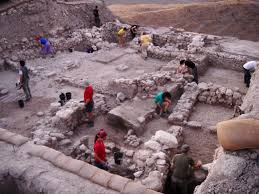
A picture of Luke participating in the archaeological dig at Tel Lachish

Luke is a minister at North Terrace Church or Christ in Temple Terrace, Florida. He holds an MA in Ancient and Classical History and has participated in archaeological digs at Khirbet Qeiyafa and Tel-Lachish. You can find his insightful posts about archaeology and other subjects, as well as information on tours that he leads at https://www.lukechandler.wordpress.com/

Thanks for taking the time to answer a few questions regarding your archaeological experiences Luke.
What first kindled your interest in archaeology?
I grew up with the Bible and occasionally heard or read about artifacts from biblical times. My parents had a college friend who was involved in the excavations at Tel Lachish during the 70’s and 80’s. He visited once when I was 8 or 9 years old and let me hold an oil lamp from around the 10th century BC, the period of the early Israelite monarchy. This fascinated me and kindled an interest that eventually became my college major. When I decided to become a minister, archaeology became even more interesting, especially as it related to the Bible.
It must be said… Indiana Jones made archaeology look cool. Of course, he’s a terrible archaeologist. He does not record or preserve anything except the object of his obsession, and he destroys most ancient structures he enters. Still, he’s a lot of fun to watch and his character has introduced archaeology to new generations.

How many years have you been participating in digs in Israel and how has your “job description” evolved, if at all during those years?
This summer (2015) was my seventh year with a dig but the job hasn’t really changed. I still excavate soil and stones, sift dirt for small finds, identify and clean architecture, discover things that were last seen and touched thousands of years ago, and have a wonderful time doing it. The job also means getting to know like-minded people from around the world, which is as enjoyable as the dig itself.
Since I’m not staff (which requires additional time with the dig), I don’t manage the paperwork or take part in the off-season research and analysis. I’ve learned to do a couple of additional things in the field but it’s best to say that after several years I am a “more experienced” archaeological volunteer.

An archaeological dig is hard work, but also fun and rewarding.

What advice would you give to someone who has never been on an archaeological dig and how can they best prepare themselves to join one?
If you’ve never been, don’t worry. It’s honest work but it’s not overbearing, and some jobs are fairly easy. In the end, the archaeologists know we are all volunteers and they want to make us happy.
How can you prepare for a dig? Some physical preparation certainly helps, even if it is light exercise a few times a week. It can be as simple as walking, some golf/tennis, jumping jacks, etc. – anything to get the muscles accustomed to activity. You can dig without this kind of preparation but being active makes it a little easier.
The best preparation is to learn something about your dig site before going. Find out its history, both biblical and extra-biblical. What took place there? Who lived there, and what happened to them? Have previous excavations found anything? This gives context to your experience. You know why you are digging as well as the potential impact of your work.

What is the most difficult part of an archaeological dig in your experience?
The schedule is probably the most difficult if not opting for a decent bedtime. We get up each morning around 4:15am, which comes quickly if you stay up late!
That being said, it’s not a bad schedule if managed properly. Work at the site begins before sunrise and concludes at 1pm sharp. The rest of the day is pretty easy with lunch, a restful siesta, pottery washing & reading (a good chance to sit and chat, and maybe discover something new about the day’s finds), followed by an archaeology lecture and dinner. Go to bed fairly soon after dinner and you’ll be fine. Stay up too late, too often, and the mornings get tougher. Not that this problem is without remedy – God has given us caffeine.

What is the most rewarding part of that experience?
This is hard to answer. I love the thrill of discovery, when you realize you have something no one has seen or touched since Bible times. On one occasion, a friend and I were the first people in nearly 3,000 years to pass through a city gate we had just unblocked. You can’t forget moments like that.
For me, the most rewarding part is what follows the dig. Simply put, the experience changes the way you read and study the Bible. I’ve used Bible commentaries and dictionaries, studied biblical languages, read Bible-based journals, subscribed to Biblical Archaeology Review, and even traveled to Israel on a tour, but none of these gave me the same insights and perspectives as a dig. A dig gives you an up-close, intimate view of the land and the people who lived there. You do not constantly move from place to place with only minutes to appreciate what you see. You get to soak in the Bible Lands and see more of what Bible people saw. It puts you inside their heads. This has deepened my own understanding beyond words.

This is the fertility goddess mentioned by Luke. This photo is taken from his website.

What is the most exciting discovery that you, or the team you were with, ever found?
That is hard to narrow down. Finding my first sling stone stands out, as does a fertility goddess from this year, but my favorite discovery may be two jars full of burnt grain that I found in 2014. It was someone’s pantry some 3,200 years ago when Lachish was burned to the ground. Whoever the grain belonged to, they did not get to eat it before their home and city were destroyed. Were they killed in the process? Did they have to flee with no food? Those burned jars told a personal story. As a bonus, we were able to carbon date the burned grain and get an approximate date for the destruction of that city level. It is hard to select one favorite discovery, but this one is near the top.

Khirbet Qeiyafa, where Luke participated in his first archaeological dig.

There are some archaeologists, as well as Bible scholars, who believe that the kingdom of David and Solomon is largely fictional. If it existed, it certainly wasn’t as powerful and sophisticated as portrayed in the Bible. The discoveries at Khirbet Qeiyafa are thought by some to refute this viewpoint. What insights have you gained regarding this controversy, based on your experience of digging there?
Skeptics of the early Israelite kingdom have always based their conclusions on negative evidence. “We have no evidence that David was a king… No evidence of a central authority in that period… No evidence of literacy…” and so on. They rely primarily on what has not been found. The risk in this approach is that someone, someday, may find that missing something and collapse the paradigm. That seems to be exactly what has happened with my first dig site, Khirbet Qeiyafa.
At Khirbet Qeiyafa, we have uncovered a small planned city with massive fortifications. Tribal shepherds could never build something like that! It is on Judah’s border with the Philistines but from the material culture we know it was not a Philistine city. The builders were strong enough to hold off the Philistine army during the years of construction, which suggests a powerful military. The architecture and finds show strong links to other sites in ancient Judah and indications of central administration. We also found multiple inscriptions. It’s almost as if someone made a list of the “missing” evidences for an early monarchy and put all of them in one place. This site has changed the debate over the beginning of the Israelite and Judahite kingdoms.
I believe the Qeiyafa discoveries validate accounts of an early Israelite monarchy. They do not prove that David killed Goliath or that Solomon built the first temple, but are evidence of a central government in that region and in that time. This is a big deal, especially in light of what we had to work with just ten years ago. Only some of the excavation results have been formally published at this point. It will be a few more years before everything is known and available to other scholars.

Tel Lachish was an important fortified city of Judah in biblical times

As I understand it, the discoveries at Khirbet Qeiyafa have inspired Dr. Yosef Garfinkel, who directed the excavation there, to move on to Lachish. Although Lachish has been excavated in the past with some exciting finds, the layer which contains 10th century BC remains (the time of David and Solomon) has not been excavated. Can you tell us what has been learned so far in the first couple of seasons (recognizing that there are things you may not be able to reveal until they are published)?
Previous excavations identified at least eight different habitation strata and it appears the fifth one is relevant to the early kings in Judah. The problem is that not enough has been found from Level V to provide a date for its habitation. Was it built in David’s time? In Rehoboam’s reign? We just don’t know at this point. The Bible says that Rehoboam fortified the city. Does this mean he actually built Level V or that he expanded an existing settlement? Our primary goal is to obtain enough physical evidence of Level V to date it. It would be especially useful to find something organic, such as olive pits, that can be carbon dated. C-14 dating is not accurate enough to pinpoint a year but it gives an approximate range. Who knows? Maybe we’ll be lucky enough to find an inscription that zeroes in the date.
What have we found at Lachish? Oddly enough, the top five levels (dating from the Persian period back to the Canaanite period) are missing entirely from portions of our current excavation area. On the first day of the first season, some people in my group uncovered Level VI just a couple of inches below the surface. We don’t know why this is. One possible explanation is that these layers were removed from our area in the 8th century BC to build stronger defenses elsewhere in the city during an attack. We may get a solid answer to this in the future. We may have found Level V in another area of the site, though we won’t know for sure until we resume digging next summer
We have been able to find wonderful things from the Canaanite civilizations that preceded the Judahites at Lachish. We have found a temple with multiple idols/figurines, imported pottery, an inscribed Egyptian scarab, and at least one inscription. We’ve also identified some new entrances to the city that are currently blocked. We plan to begin opening and dating them next year. It’s possible one of these gates is from the elusive Level V. The Bible does not tell us much about the early Divided Kingdoms, so our work over the next few years may impact on our understanding of that period. It is exciting stuff.

Is there anything else about an archaeological dig that you would like to add Luke?
Let me say one thing for anyone who has not yet experienced a dig… If you want a deeper understanding of the Bible and its world, find a way to get yourself on a dig, even if just for a couple of weeks. It will give you understanding and insights that no book can provide. You will benefit from it the rest of your life, along with others whom you teach or influence. I’ve excavated with people as young as 13, with others who are in their 70’s, and with every age in between. Most of the best digs are open for people just like you. The sooner you go, the longer – and greater – the benefit will be.
– – – – – – – – – –
Thanks for taking the time to answer these questions Luke and may God continue to bless the work that you are involved in. I am hoping to join you at Tel-Lachish in the season after next, Lord willing. For any who might be interested in learning more about joining an archaeological dig you can contact Luke at his website (regarding Lachish), or you can go to biblicalarchaeolgy.org and click on the “digs” menu.

Amasa and His “Blood Brothers” in 2 Samuel

Amasa and His “Blood Brothers” in 2 Samuel

Joab murdered his own cousin Amasa in order to hold on to his position as commander

One of the interesting, but admittedly gruesome, features of 2 Samuel concerns the stabbing of 4 different men in the stomach. The stories are tied together by this (un)common theme. The first two killings occur between rival houses for the throne–i.e. members of Saul’s and David’s house killing one another. The first incident involves Abner of the house of Saul killing Asahel, the nephew of David (2 Sam. 2:18-23). For a more indepth treatment of this incident see my post entitled: “Asahel: Running into Trouble.” The second incident involves Joab and his brother Abishai of the house of David (and brothers of Asahel) killing Abner of the house of Saul (2 Sam. 3:26-27). The first killing happens during a time of battle, and in spite of Abner’s pleadings for Asahel to stop pursuing him. The second killing is more treacherous as Joab lures the unsuspecting Abner into a trap and murders him. Although these killings are both tragic because they involve rival houses during a time of hostility, they are, to some extent, understandable.

Ish-bosheth's own captains murdered him while he slept.
Ish-bosheth’s own captains murdered him while he slept.

The second set of killings, however, are more shocking. They are “in-house” killings. Ish-bosheth is stabbed by fellow Benjamites, captains of his own army (2 Sam. 4). Amasa, another nephew of David, is brutally dispatched by Joab, who is not only a nephew of David, but a cousin of Amasa (2 Sam. 20:8-13). Thus there is a steady progression of brutality and violence as we read through the story in 2 Samuel tracing this theme of 4 men who “get it” in the belly. The writer seems to linger a little longer over the death of Amasa. It is the last in this gory chain of stabbings and provides a climax in several ways. First, Joab’s killing of a fellow cousin through the deception of a kiss, and the callous treatment of Asahel as he lies “wallowing in his blood in the middle of the highway” (2 Sam. 20:12), presents the most tragic and gruesome scene of any of the 4 accounts. Second this scene intentionally recalls the other 3 accounts. In my book, Family Portraits: Character Studies in 1 and 2 Samuel, my concluding thoughts on Amasa’s character study provides a summary of the similarities and differences between these accounts and some of the lessons to be learned from them. That conclusion is reproduced below.

Conclusion: Amasa and His “Blood Brothers”

family portraitsOne cannot read the account of Amasa’s death without recalling the violent deaths of other men in 2 Samuel. As Polzin notes, “2 Samuel makes it clear that Joab’s smiting of Amasa in the belly looks backward to the murders of Ishbosheth in 4:6, Abner in 3:27, and Asahel in 2:23. Moreover, these instances of ‘smiting in the belly’ occur only here in 2 Samuel, and always in the context of an explicit reference to ‘brother.’ ” These similarities invite the reader to compare and contrast the four different stories.

Parallels between the deaths of Abner and Amasa are especially noteworthy. They both share the same murderer: Joab. In both cases Joab deceived the men he murdered by catching them off guard and striking them in the stomach (3:27; 20:10). Both were commanders over their respective armies, who fought and lost a civil war against David (2 Sam. 2:12–17; 17:25). Joab perceived the reconciliation of both men to David as a threat, and both were killed in an atmosphere of “peace” (3:21–23; 20:9). Joab’s murder of these men threatened to disrupt the tenuous unity recently forged in both situations. Finally, David himself drew a parallel between these two murders, advising Solomon to deal with Joab accordingly (1 Kings 2:5–6).

These similarities provide the backdrop for the contrast between the two deaths. Although the narrative makes it clear that Joab was wrong in murdering Abner, at least the author provided him with some motivation: Abner’s killing of Joab’s brother Asahel (3:30). No such explanation is provided for the murder of Amasa; indeed, none can be. The silence of the text convicts Joab. Perhaps the text’s silence also suggests that Joab had reached such a hard-hearted state in his killing of others that he no longer felt the need to justify his actions.

Amasa and Joab were cousins. Both were sons of David's sisters.
Amasa and Joab were cousins. Both were sons of David’s sisters.

A final contrast that highlights the heinous nature of Amasa’s murder is that he was a blood relative of Joab from the house of David, whereas Abner belonged to the rival house of Saul. The murder of Amasa sounds a climactic note in 2 Samuel on the consequences of the abuse of power. Joab’s unrestrained lust for power begins with killing his fellow-countryman (Abner) and ends with killing his own kinsman (Amasa).

Besides the act of “smiting in the belly,” a number of other similarities also connect Amasa’s death with Asahel’s. Both stories center on Gibeon (2:12; 20:8). Each story speaks of “pursuing” an enemy, and in each case the battle ends by Joab blowing the trumpet (2:28; 20:23). The root ʾaḥar (“after”) occurs frequently (11 times) in the account of Amasa’s death, as it does in the story of Asahel. Furthermore, in both accounts the author vividly relates the gruesome nature of the death and comments that those who came upon the scene “stood still” (2:23; 20:12).

The difference between Asahel’s death and Amasa’s highlights again the brutality of Joab’s action. Since Asahel and Abner are on opposite sides in the battle, it is not surprising that one would kill the other. Amasa and Joab, however, are on the same side. Abner warns Asahel twice (2:21–22) before delivering the deadly blow, whereas Joab lulls Amasa into a false sense of security, and then kills him without warning (20:9–10).

The similarities of Amasa with Abner and Asahel also suggest certain character traits that they share. Both Abner and Amasa are caught unaware and “die as a fool” (3:33). Asahel’s inexperience contrasts with Amasa’s experience, but both prove to be naive in their own way.

Sadly, there is not much of a positive nature that can be said of Amasa. He was the nephew that betrayed his uncle the king. He was the general who lost a war, and the ineffective commander of David’s troops who could not fulfill his commission. In the end he dies the death of a fool, his body disgraced by being dumped in a field, ultimately forgotten by his men, and by the narrator as the story continues without him. Amasa, as commander of the army (both David’s and Absalom’s), has all the outward trappings of success, but his life is a dismal failure. His cruel death evokes sympathy, but his betrayal of the Lord’s anointed appears to reap consequences that go beyond the civil war. His under-achieving seems to be related to his lack of true perception (he did not recognize the Lord’s anointed or the sword in Joab’s hand). As such, he becomes a warning to all who might “dress for success” and look the part, but inwardly lack the real quality of greatness: a quality that comes only by aligning oneself with the Lord and His purposes.