Abiathar: The Meaning of Biblical Names

Abiathar: The Meaning of Biblical Names

When Saul slaughtered the priests at Nob, Abiathar managed to escape with the ephod and flee to David (1 Sam. 23:6)

Abiathar was a high priest during the reign of David (2 Sam. 20:25). Although he appears frequently in the narratives of 1&2 Samuel, he is a minor character. He never speaks in the narrative, except once indirectly when it is said that he informed David of Saul’s slaughter of the priests (1 Sam. 22:21). The main importance of Abiathar is that he provides a way for David to communicate with God. When he escapes from the slaughter of the priests, we are informed that he brought the ephod with him (1 Sam. 23:6). The ephod was a priestly garment which contained pockets in which the Urim and Thummim were kept (Exod. 28:28-30). In some way, not exactly clear to us, the high priest used these items to determine God’s will.


Family Portraits photoAlthough no particular attention is drawn to the meaning of Abiathar’s name in the narrative, its various meanings fit the context of 1&2 Samuel quite nicely. The following is an excerpt on the meanings of Abiathar’s name from my book Family Portraits: Character Studies in 1&2 Samuelincluding a few explanatory comments in parentheses.

One of the most intriguing things about Abiathar is his name, which has an interesting range of meaning. “āḇ” means “father” in Hebrew. The second part of his name comes from the Hebrew word yāṯār meaning “remainder,” or “what is left over,” and is also related to the idea of “abundance.” Therefore, his name can mean “the father’s (God’s) abundance,” or “the father’s remnant.”

Both of these meanings have an important relationship to what we have learned about Eli’s family in 1 Samuel (see Family Portraits here for more detail). When yāṯār is translated as “abundance,” it can be used as “a technical sacrificial term that always occurs in conjunction with the liver” (cf. Exod. 29:13, 22; Lev. 3:4, 10, 15). It refers to an appendage or covering of fat that is to be sacrificed along with the liver” (emphasis mine).

It might be recalled that Eli’s family has a notorious history concerning “fat” (1 Sam. 2:16, 29; 4:18). In addition, the word for “liver” is from the word kāḇēḏ (the word “heavy” in the Eli story). This is not to suggest that Abiathar is guilty of stealing the fat as Eli and his sons did, at least not literally (I explore the potential ramifications for this later in the chapter however). Rather, his name may be a celebration of the “abundance” that his family had experienced since the destruction at Shiloh. In spite of the fact that people like Ichabod, Ahitub, and Ahijah may have died prematurely, 1 Samuel 22:18 tells us that the house of Eli consisted of 85 men before the destruction at Nob. Therefore, “Abiathar” may be an expression of thanks for God’s “abundance,” in spite of the prophecy of doom which hung over the family. Whatever the reason, it is interesting to note that the idea of “fat” continues to follow the family of Eli. However, this “fatness” becomes “leanness” when Saul kills all the priests at Nob except Abiathar, which leads to a consideration of the second meaning of Abiathar’s name.

Because the word yāṯār carries the meaning “what is left over” it can refer to “excess” (hence “fat”), or to “what remains,” which invokes the idea of scarcity. This word is sometimes used interchangeably with another Hebrew word which means “remnant” (shaʾar). Therefore, yāṯār can be used in the sense of “few,” or even “none” (e.g., Exod. 10:15; 2 Kgs. 4:43-44). This meaning is, of course, very applicable to the name “Abiathar” after the destruction of the priests at Nob, since he alone escapes (1 Sam. 22:20).

Abiathar’s “aloneness” is confirmation of the prophetic word of judgment (1 Sam. 2:27-35), but it is also a word of grace. The concept of “remnant” in Scripture is set within the context of grace. The idea is that, in spite of mankind’s wickedness, God does not utterly destroy, but always leaves himself a remnant. In the days of Ahab and Jezebel, God tells Elijah that he has reserved for himself a remnant of 7,000 that have not bowed the knee to Baal (1 Kings 19:18). The concept of a godly remnant is also very important to the book of Isaiah (e.g., Isa. 7:3). Discussing the biblical principle of the remnant, Paul writes, “Even so at this present time there is a remnant according to the election of grace” (Rom. 11:5). So while Abiathar’s name is a reminder of the judgment that fell on the house of Eli, it is also a reminder of God’s grace. (Family Portraits, pp. 89-91).

Family Portraits: Character Studies in 1 and 2 Samuel is available at Amazon USA / UK and WestBow Press and Logos.com

Biblical Numbers or Numerology

Biblical Numbers or Numerology

Biblical Numerology is available at Amazon USA / UK
To learn more about the use of biblical numbers, purchase Biblical Numerology at Amazon USA / UK

Does the Bible contain a secret code using numbers? If we count up numbers of words in a sentence, or add together the numerical values of a word or sentence, is there a hidden message contained in it? No doubt you have heard a pastor or Bible teacher say that the number 7 represents completion or perfection, or perhaps that the number 40 represents judgment (e.g., the Flood, the Wilderness wanderings). Where do such interpretations come from? Do biblical numbers such as 7, 10, 12, and 40, as well as others, have symbolic meaning or should they always be understood literally? What about the large numbers in the Old Testament? Some archaeologists and Bible scholars say that some of the numbers in the Old Testament are impossibly large. For example, are we to take the census numbers in the Book of Numbers literally? If so, is it realistic to believe that the Israelites who left Egypt and wandered in the Wilderness for forty years numbered between 2-3 million? These are some of the interesting questions dealt with by John J. Davis in his book entitled Biblical Numerology. Because this topic has so many interesting facets to it, I will spend several posts dealing with the various issues raised in the use of biblical numbers. In this post (utilizing Davis’s insights), I will look at the various ways in which numbers were written in the ancient world and how an understanding of that impacts the use and understanding of biblical numbers.

How Numbers Were Written in the Ancient World and in the Bible

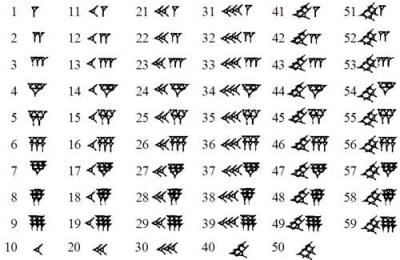
This chart shows an example of how Babylonian numerals were written using symbols.

To be honest, I had never given any thought as to how ancient peoples wrote numbers. I assumed that they used numerical symbols like we do. “Why does it matter?”, you might ask. Good question, read on! Davis points out that there were three different ways that numbers were written in the ancient world.

  1. The number could be spelled out (as in “seven”).
  2. Numerical symbols might be used like our number “56,” however the use of numerical symbols was much more complicated in the ancient world. For example, the number 4 might be written with 4 straight lines like this: ||||. Writing larger numbers could become very complex (see the photo on the right).
  3. A third way was to assign a value to various letters of the alphabet. We are most familiar with this system through the use of Roman numerals (e.g., IV = 4, L = 50).
Although the Mesha Stele is Moabite, not Israelite, the two languages were very similar. The Mesha Stele uses numbers, but they are spelled out, not written with symbols.
Although the Mesha Stele is Moabite, not Israelite, the two languages were very similar. Like biblical numbers, the numbers used on this Stele are also spelled out.

What about biblical numbers? Does the Bible use all three ways of writing numbers? Interestingly, the answer is “no.” The only method employed by the Bible is to write the number by spelling it out. Davis believes that ancient Israelite scribes probably “would also have used symbols since their neighbors did” (p. 34). However, not only does the Bible never use such symbols, we have yet to discover any Israelite document or inscription that uses numeric symbols! Even such discoveries as the inscription in Hezekiah’s tunnel known as the “Siloam Inscription,” or the Mesha/Moabite Stone, which employ the use of numbers, do not use numeric symbols, but instead spell out the numbers.

What about the alphabetic system of writing numbers? The earliest evidence for the Jewish use of this system (employing Hebrew letters to represent numbers) dates from the Maccabean period, to the reign of Simon where it has been found on coins dating to 143-135 B.C. (p. 38). Davis notes that, “the idea of alphabetic numbering was probably a fifth or fourth century B.C. development,” which originated with the Greeks (p. 44). It was Greek influence, following Alexander the Great’s conquests, which brought this system to the Jewish people (p. 45). Therefore, while this system could possibly have been employed by writers of the New Testament (e.g., Rev. 13:18–“666”!), it is much too late to have been used by Old Testament writers.

This means those who try to demonstrate some type of hidden code by totalling up the value of Hebrew letters  (known as “gematria”) have a lot of explaining to do. If such a system was developed by the Greeks and only borrowed by the Jews sometime after Alexander (4th century), then it is difficult to sustain the theory of the use of gematria in the Old Testament. Having said that, Davis does acknowledge that the ancient Babylonians (not the “Neo-Babylonians”), as well as Greeks from the time of Homer (900 B.C.), seem to have some knowledge of gematria. This admission leaves the door slightly ajar, although Davis affirms that it was really with Pythagoras (6th-5th century B.C.) that “the real organization and development of the system of mystical numbers” began (p. 126). In a future post we will explore the origins and use of mystical numbers in more depth.

In our next installment of biblical numbers, we will look at some of the large numbers in the Old Testament and ask whether they are reliable.

Brazos Theological Commentary: 2 Samuel

Brazos Theological Commentary: 2 Samuel

The Brazos Theological Commentary on 2 Samuel is available at Amazon USA / UK

The Brazos Theological Commentary Series takes a different approach from most Bible Commentaries. Commentators are chosen on the basis of their knowledge and acquaintance with Church Doctrine over the past two thousand years. They are theologians (hence the title of the series), not necessarily historians or language experts, as is frequently the case with other commentary series. This does not mean that authors in this series are unfamiliar with the ancient languages or history, only that their expertise lies in the realm of theology. As such, they are expected to interact with the text through the medium of historical theology. Thus, in the Brazos series one will frequently see references to the great theologians and philosophers throughout the history of the Church. People like Irenaeus, Origen, Augustine, Thomas Aquinas, Luther, Calvin, and a host of others frequent the pages of this series of commentaries.

This approach has its pluses and minuses. It’s fascinating, and quite often informative, to hear the reflections of these ancient theologians, as the Brazos commentator seeks to integrate their thoughts into an interpretation of the text. Depending on the commentator, however, it can at times be quite abstruse and esoteric (like the words I am using here!). With some of the commentaries in the Brazos series, I have found myself in deep water, wondering how I got there and if I would ever make it back safely to the land of biblical understanding. I must confess that with a few commentaries in this series it has been necessary to jettison them overboard because of the heavy, mind-bewildering theological freight they carry. Thankfully, that is not the case with the Brazos Theological Commentary on 2 Samuel by Robert Barron. Although Barron engages with the great theological thinkers of the ages, his commentary is clear and easy to read, while often full of wonderful and surprising insights. As I noted in a previous post (Is King David a New Adam?), Barron’s typological/analogical approach to the David story provides some interesting food for thought.

Strengths of the Brazos Theological Commentary on 2 Samuel

As noted in a previous post (NIV Application Commentary:1&2 Samuel), I have a mental checklist of things that I look for when reading any commentary on 1&2 Samuel. One of these items includes the commentator’s assessment of the various characters in Samuel, especially those whose character traits are somewhat ambiguous. I list here a sample of Barron’s thoughts on various characters:

Abner

  1. There are some who are preoccupied with power but not necessarily with honor, and Abner seems to be such” (p. 25).
  2. Abner evidently is not particularly interested in being king himself, but he is, like many behind-the-scenes players across the ages, deeply interested in holding the reins of power” (p. 32).

Joab

  1. Joab is speaking in the cadences and tones of the serpent (notice the allusion to the Garden of Eden, see my previous post), unduly planting suspicion and stirring up dissension without cause” (in reference to Joab’s negative response toward Abner’s peace proposal in 2 Sam. 3, p. 35).
  2. He is decidedly not someone who should be in a position of political leadership. He functions therefore as a symbol of the lethal violence that would plague Israel for centuries following the time of David” (p. 175).
  3. Regarding Joab’s protestations to the woman at Abel in 2 Samuel 20 that it is against his nature to destroy, Barron quotes Joab’s words and adds the response which follows. “‘Far be it from me, far be it, that I should swallow up and destroy! That is not the case!’ (2 Sam. 20:20-21). As even the most inattententive reader of this story knows, it is indeed the case” (p. 176).

Ziba & Mephibosheth

  1. Commenting on Ziba’s words in 2 Samuel 16:1-4: “What becomes clear just a few chapters later is that this little speech by Mephibosheth’s slave amounts to Ziba’s rather pathetic attempt to ingratiate himself with the vulnerable king and to denigrate any potential rivals” (p. 148).
  2. Regarding Mephibosheth’s response to David in 2 Samuel 19:30: “It would be hard to construe this intervention as anything other than a sincere acknowledgment of joy and gratitude on the part of Mephibosheth and thus as a fairly clear indication that Ziba was lying” (p. 170).

In my opinion, these are astute character observations on the part of Barron. Bible commentators are not always as discerning in making these finer judgments on ambiguous characters, which demonstrates his careful reading of the text.

David’s Attitude Toward Saul According to Barron

Robert Barron is the author of the Brazos Theological Commentary on 2 Samuel

As any who have read anything I’ve written on 1&2 Samuel will be aware, I am not a fan of the school of interpretation known as “the hermeneutic of suspicion” (see  e.g., my book, Family Portraits, p. 265, n. 22) which suggests that the author’s insistence on David’s innocence regarding Saul and his family is all a carefully orchestrated ruse. I am glad to see that Barron does not fall into this camp of interpretation. Regarding David’s actions toward Saul Barron states, “A somewhat cynical reading would suggest that David wanted to advertise as far as possible his warm feelings toward the house of Saul so as to hold off the suspicion that he had been actively involved in causing the death of the king. Though attractive to postmodern interpreters, such a reading, in my view, does not shed the most light. Yes, Saul relentlessly pursued David, but nothing in a straightforward reading of 1 Samuel would justify the claim that David was harboring a hidden grudge against the king” (p. 18).

Weaknesses of The Brazos Theological Commentary on 2 Samuel

Barron’s outline of 2 Samuel is based on a thematic approach which doesn’t always take the structure of the text into consideration. The outline of his commentary is as follows:

  1. David Comes to Power (2 Samuel 1-2)
  2. Priest and King (2 Samuel 3-10)
  3. David and Bathsheba (2 Samuel 11)
  4. A Sword Will Never Leave Your House (2 Samuel 12-20)
  5. Toward the Temple (2 Samuel 21-24)

There are several problems with this division, no matter how convenient it might be for purposes of the commentary.

  1. It separates 2 Samuel 2 from chapters 3-4. 2 Samuel 2-4 is a unit held together by David’s kingship in Hebron, the civil war between David and Ish-bosheth, and the prominent place in the narrative given to Abner and Joab.
  2. 2 Samuel 5 clearly begins a new unit with David being anointed king of all Israel and his conquest of Jerusalem. This unit seems to end with a summary of David’s righteous rule and a list of David’s cabinet members in 2 Samuel 8:15-18
  3. Almost all scholars take 2 Samuel 9-20 as a unit. A second list of David’s cabinet members at the end of 2 Samuel 20:23-26 forms an inclusio with the list at the end of chapter 8, while the intervening material (chs. 9-20) is all about the circumstances that lead to various crises in David’s kingdom. (Barron seems to be aware of all of this. For example, even though he separates the story of David and Bathsheba by itself, he notes its intimate connection with chapter 12–p. 107).
  4. While all recognize that chapters 21-24 form the close of 2 Samuel, Barron’s title for this section seems a bit overstated. “Toward the Temple” may describe chapter 24, but I’m not sure how it fits with the other sections in the conclusion of the book.

In spite of my criticisms here, Barron’s divisions of the text (no doubt to emphasize the theological points he sees as most important), are not detrimental to his overall treatment of 2 Samuel.

In my opinion, the more serious weakness of this commentary lies in Barron’s acceptance of the judgments of critical scholarship regarding certain troublesome passages. For example, concerning whether Absalom had sons or not Barron states, “These irreconcilable accounts are the result, no doubt, of different traditions that the editor carelessly conflated” (p. 134). I have suggested elsewhere that there are good reasons for the seeming contradictory accounts of how many son’s Absalom had (see my articles here and here). My point is not that Barron should have checked with me (!), but that scholars are all too frequently ready to throw in the towel with textual problems such as this, by simply saying, “Oh well, that clumsy editor did it again!”

Another example is in regards to the infamous Elhanan passage in 2 Samuel 21:19. Throughout the commentary, Barron speaks as if David was the champion who killed Goliath. For example, speaking of David, Barron states, “We see here the typical cleverness of the one who had outmaneuvered Goliath” (p. 49). However, when commenting on the Elhanan passage, Barron states, “What seems most plausible in point of fact is that the account in the present chapter is the correct one, and that it was later associated with the young David and retold with particular literary flare by the final editor of the Samuel literature” (p. 185). There are two problems here in my opinion. First, Barron is contradicting himself. If David did not in fact slay Goliath, then he did not “outmaneuver” him as Barron claims on page 49. Second, I have a problem with claims that biblical authors or editors embellished stories and attributed them to others. This means that facts were deliberately distorted, which doesn’t jive with a conservative (and I would argue more biblical) understanding of inspiration.

Evaluation

Every fish has its bones, and in spite of my disagreements with some of Barron’s viewpoints, I found his commentary to be very helpful and insightful. I would recommend it, not only to pastors and teachers, but also to the mature Christian seeking to grow in his or her understanding of the books of Samuel. This is one Brazos commentary that doesn’t leave you lost at sea.

Is King David A New Adam?

Is King David A New Adam?

In his recent commentary on 2 Samuel, Robert Barron suggests that David is a new Adam.

David is indeed a cagey and capable new Adam, both tending and defending the new Eden,” so Robert Barron contends in his recent commentary on 2 Samuel (2 Samuel, Brazos Theological Commentary, p. 24). According to Barron, David is a new Adam, Israel is the Garden of Eden, and David’s enemies (e.g., the Amalekites, and even Absalom) represent the serpent. This typological approach is an interesting perspective from which to view 2 Samuel. It definitely causes one to think outside of the box.  While this might seem like an eccentric approach at first, scholars have noted for years the connections between Genesis and 1&2 Samuel. In fact, Barron’s approach is indebted to G.K. Beale who makes similar comparisons (A New Testament Biblical Theology: The Unfolding of the Old Testament in the New). Although Barron’s overall approach has an element of typology in it, it would be unfair to characterize the entire commentary this way. In this post I will explore the connections he makes between King David’s kingdom and Genesis and in a future post I will review and evaluate his commentary on 2 Samuel.

How Does David Function as a New Adam in 1&2 Samuel?

According to Genesis 1:28, Adam was created to rule over creation.

Barron notes that the dominant theme of 2 Samuel is the “contrast between the kingly path taken by Saul and that taken by David” (p. 3). This contrast introduces such questions as: “Does Israel require a king? What makes a king good or bad? How does the kingship of Yahweh relate to human kingship?” (p. 3). To answer these questions, Barron asserts that it is necessary “to return to the very beginning of the Bible, to the accounts of creation and the garden of Eden” (p. 3). Therefore, Barron’s typological approach is borne out of the necessity of understanding the fundamental problems encountered in the initial episodes of Genesis. He notes, as do many commentators on Genesis, the original couple was created to rule over creation. They were given “dominion” (Gen. 1:28). Thus Adam was the first king. Through “tilling” the soil and “keeping” the garden, Adam functioned as a good king. His rule, like that of the God whose image he was created in (Gen. 1:27), was to be benevolent, not oppressive (pp. 4-5).

Saul's rejection of God's word equates him with the old Adam rather than the new Adam.
Saul’s rejection of God’s word equates him with the old Adam rather than the new Adam.

Unfortunately, the rule of the first king and queen ended in failure, a “consequence of bad leadership” (p. 5). The reason for expulsion from the garden is a result of rejecting God’s word and seeking to “rule without reference to God” (p. 5). At this point, the typological parallels with 2 Samuel become significant. As Barron notes, the theme of 2 Samuel (and we could also include 1 Samuel) is the difference between Saul’s and David’s kingship. Like rebellious Adam, Saul’s offense is a rejection of the word of God (1 Sam. 15:23). Saul is noted throughout 1 Samuel for making his own decisions without reference to God. This insight is very important in understanding the message of 1&2 Samuel correctly. Scholars such as Gunn and Jobling seek to excuse Saul on the basis of misinterpreting God’s/Samuel’s commands. In the view of these scholars, God (and Samuel) becomes a malevolent presence intent on dooming Saul no matter what he does. However, the parallels with Adam, which Barron draws upon, act as a biblical aid in clearing up this scholarly misinterpretation of the story.

PianoIn a helpful analogy, Barron compares God and his law to someone seeking to learn piano or golf. The instructor lays down certain rules, if followed, these rules lead to a person finding the freedom to become an excellent piano player or golfer. “The lawgiving instructor is therefore not the enemy of the student’s freedom but rather the condition for its possibility” (p. 14). Similarly, Saul’s rejection of God’s commandments is what makes him a failure as king, just as Adam’s rule in the garden failed because of his disobedience. In contrast, as a new Adam, David is the man after God’s heart. One illustration of this is his treatment of Saul. Barron notes that, “David’s stubborn unwillingness to do violence to Saul is another sign of his kingly worthiness, for it indicates that his actions were predicated not primarily on self-interest but rather on an attentive listening to the voice of God” (p. 15).

jacobs-prophetic-blessing-4-638Barron also seeks to demonstrate a connection between Adam and David by tracing this connection through biblical history. Following the history of sin in Genesis 1-11, God makes a new start with Abram. Barron states, “Abram will be a new Adam, cultivating a new Eden and expanding the boundaries of that ordered garden to include all the peoples of the world” (p. 6). The promise to Abram of numerous descendants recalls the original command to Adam to “be fruitful and multiply.” “The royal promise is extended to Abram’s grandson” (i.e. Jacob, p. 7). Through Jacob, the nation of Israel is birthed whom Barron sees as a “‘corporate Adam’ endowed with the privileges and bearing the responsibilities of the first tender of the garden” (p. 7). It is through Jacob’s deathbed blessing that, “the kingly task will be passed on to and through Judah and his tribe” (p. 7).  Barron continues tracing the theme of kingship by noting, “Throughout these opening books of the Bible, Yahweh has not yet found the king in whom his own divine purposes can become utterly incarnate. Hence Israel’s identity remains compromised and its mission unfulfilled.  It is against this rich and complex background that the emergence of Saul and David in the first book of Samuel has to be interpreted” (p. 7). Therefore, “from Adam on, Israel is marked by both good and bad kingship. God (and Samuel) stand opposed to those forms of kingship that mimic the style and substance of the kings of the surrounding nations, but they ardently desire a form of kingship in accord with God’s designs” (p. 8).

In 1 Samuel 12, Samuel exhorts the king and people to obey God.

Tracing the theme of kingship from Creation to David, not only substantiates Barron’s approach, it also helps to explain what many scholars see as a contradictory view of kingship in 1 Samuel. In 1 Samuel 8-12, scholars frequently note the interplay between positive and negative statements about the kingship. Some are at a loss to explain these seemingly contradictory views, while others see it as the result of a clumsy editor. Barron’s approach demonstrates that kingship has always been a part of God’s plan and purpose. However, it is not simply kingship per se that God seeks to bestow–that is, kingship as defined by the world–but rather a king that would honor and obey God. This is the point of Samuel’s speech in 1 Samuel 12: “If you fear the Lord and serve Him and obey His voice, and do not rebel against the commandment of the Lord, then both you and the king who reigns over you will continue following the Lord your God. However, if you do not obey the voice of the Lord, but rebel against the commandment of the Lord, then the hand of the Lord will be against you, as it was against your fathers” (vv. 14-15).

While the old Adam (Saul) does not deal a decisive blow to the Amalekites, the new Adam (David) deals with all of Israel's enemies.
While the old Adam (Saul) does not deal a decisive blow to the Amalekites, the new Adam (David) deals with all of Israel’s enemies.

Barron also sees his approach as a helpful way of characterizing Israel’s (David’s) enemies. For example, he is hard pressed to understand God’s command to utterly destroy the Amalekites. “Why in the world would God decree that this beleaguered little people should be ruthlessly and relentlessly attacked?” His answer is to see Origen’s allegorical approach as helpful in this case. “Origen argues that, throughout the Bible, Israel stands for the ways and purposes of God, and the enemies of Israel stand for those powers that are opposed to God” (p. 9). He continues, “These various peoples are symbolically akin both to the tohu wabohu [formlessness and void] (Gen. 1:2) from which God brought the ordered world and to the serpent that Adam rather unsuccessfully managed in the garden. Though it is not entirely clear why this should be the case, the biblical authors seem to isolate Amalek as particularly expressive of this ‘nothing’ that militates against Israel” (p. 10). Although I’m not so sure that “beleaguered” is a correct designation for the Amalekites, nonetheless, I believe he (and Origen!) are correct in seeing these enemy peoples as a manifestation of the “seed of the serpent” (Gen. 3:15). As a result of Saul’s disobedience, Barron asks the following provocative questions: “Might Saul’s unwillingness to slaughter the herds of the Amalekites and to put to death their king symbolically represent the sort of confusion in regard to intrinsically evil acts that undermines God’s purposes? And therefore might one come to sympathize with Samuel’s conviction that Saul has, by this act, effectively forfeited his kingship?” (p. 10). In other words, a king who doesn’t protect his people against their enemies, is no king at all. And just as certainly, a king who does not wage war with God’s enemies, cannot be God’s  (or a godly) king.

Conclusion: King David is a New Adam

While there were times in my reading of Barron’s commentary on 2 Samuel, that I thought he was perhaps carrying the analogy of David as the new Adam too far, I must admit that I always found his interpretations challenging me to think of this narrative in new ways. The above examples I have given are not an exhaustive catalogue by any means of the comparisons made between David and Adam, but they are enough to demonstrate that such an approach is indeed fruitful. I also believe it proves helpful in getting at the significant theme(s) of 1&2 Samuel which modern scholarly efforts sometimes cloud. Like all typological/allegorical approaches, each interpretation must be questioned and validated. But, as I have written elsewhere (Typology: A Key to Interpreting the Bible), typology is an important method that allows Scripture to interpret Scripture. Barron’s commentary is an excellent contribution on Samuel studies and in my next post I will review it as a whole.

NIV Application Commentary: 1&2 Samuel

NIV Application Commentary: 1&2 Samuel

The NIV Application Commentary on 1&2 Samuel is available at Amazon USA / UK

The NIV Application Commentary series is aimed at providing the best scholarly insights into the text, while also providing contemporary application. To accomplish its purpose, The NIV Application Commentary series divides comment on the text into three parts: 1) Original Meaning (“All the elements of traditional exegesis–in concise form–are discussed here,” p. 9); 2) Bridging Contexts (distinguishing the timeless message(s) of the Bible from the time-bound text); and 3) Contemporary Significance (do I need to explain this one?) Arnold’s 1&2 Commentary begins, like others, with a brief 20-page introduction. The introduction includes topics such as how to read the historical books, authorship, an overview of the contents of 1&2 Samuel, theological themes, etc.

Central Themes of 1&2 Samuel According to the NIV Application Commentary

Arnold understands the overall theme of 1&2 Samuel to center around two questions:

1) “What is the acceptable nature of the Israelite monarchy?”

2)”Who can serve suitably as king?”

The first question is primarily addressed in 1 Samuel 1-15, while the second question occupies the material in 1 Samuel 16 — 2 Samuel 24 (p. 32). I found the second question concerning who is suitable as king to be a very insightful way of understanding the contrast between the kingships of Saul and David.

In the NIV Application Commentary on 1&2 Samuel, Bill Arnold notes the key place that repentance plays in the overall storyline.
In the NIV Application Commentary on 1&2 Samuel, Bill Arnold notes the key place that repentance plays in the overall storyline creating what I call a “repentance sandwich.”.

Arnold notes three main theological themes in 1&2 Samuel. The first concerns the  above question of who is suitable to be Israel’s king, or the messianic theme. Arnold states, “The concept of an ideal anointed one arises gradually and is sustained in the narrative” (p. 36). Another theme which grows out of the two main questions concerns the use and abuse of power. Arnold sees the messianic and power themes bound together by a third theme dealing with the nature of repentance. He insightfully points out that, “The books of Samuel . . . contribute graphic illustration to the Bible’s teaching on the precise nature of confession and repentance through the three portraits of Samuel, Saul, and David” (p. 38). The key passages are 1 Sam. 7:2-6; 1 Sam. 15; and 2 Sam. 12.

Through Samuel, the first story illustrates “the nature of true confession and repentance.” In the second account, Saul, “acknowledges wrongdoing instead of repudiating it; [He] regrets his actions because they leave him vulnerable, not because they were self-destructive and offensive to God” (p. 39, author’s emphasis). The third narrative concerning repentance involves David’s straightforward confession which illustrates true repentance, the kind of repentance that Samuel had urged upon Israel so many years before. The book also concludes with a fourth story of repentance (2 Sam. 24). On this occasion, David does not even need a prophet to convict him of wrongdoing, but confesses on his own, demonstrating growth in his relationship with God. Thus, these three characters form a “repentance sandwich” (my expression). The outer layers (Samuel and David) show what true repentance is, while the inner layer (Saul) demonstrates what it is not.

Agreements and Disagreements with the NIV Application Commentary on 1&2 Samuel

agree-or-disagree-1-638One way to evaluate a commentary is to examine how it treats important topics or controversial passages. I have a mental checklist that I go through when reading a commentary on Samuel. Some of the items on my checklist are important, others are a matter of curiosity (how is the commentator going to deal with this?). Below I have listed a few of the items on my mental checklist. This is not an exhaustive list, nor will I have space in this post to reflect on how Arnold deals with each of these. However, after sharing the list, I will examine Arnold’s interactions with some of the items on my list.

  1. How does the commentator approach the authorship of 1&2 Samuel? (How one perceives “Deuteronomistic authorship” often colors one’s interpretation of the text).
  2. Does the commentator consider Samuel to be a positive or negative influence on the narrative?
  3. Is Saul responsible for his sin, or is he a victim of a capricious God who decided from the outset that Saul would be condemned?
  4. Which reading does the author prefer concerning Goliath’s height? (this is just a matter of curiosity, but see my article Goliath’s Height).
  5. How does the author treat the problem of Saul not knowing who David’s father is in 1 Samuel 17:55-58? (Another matter of curiosity over a notoriously difficult passage).
  6. Is the commentator’s view of David wholly positive until his sin with Bathsheba, or does he see the narrative as reflecting faults earlier in David’s life?
  7. Does the commentator use a “hermeneutic of suspicion?” Which means, does he see the biblical author trying to defend a cunning David who manipulates circumstances regarding the deaths of Saul’s family members, or does he accept the author’s statements that David is innocent?
  8. Does the commentator view David and Jonathan’s relationship as homosexual?
  9. How does the commentator resolve the problem in 2 Sam. 21:19 which states that Elhanan killed Goliath?
  10. What is the commentator’s evaluation of certain characters whose actions are, at times, ambiguous? (e.g., Abner, Joab, Mephibosheth, or Ziba).

Concerning whether Saul is a victim or a free moral agent (#3 above), I believe Arnold is correct in stating, “[Saul] fails to accept the structure of authority established for him by Yahweh and his prophet Samuel at the time of his appointment (1 Sam. 13:14). . . .Thus, Saul’s guilt derives from his determination to usurp power rightly belonging only to Yahweh and his servant Samuel” (pp. 200-201). This is an important point in understanding the kind of person Yahweh is looking for as Israel’s king, and it is a point missed by those who accuse God of being either arbitrary in his forgiveness (Brueggemann), or showing his “dark side” (Gunn).

Contrary to Arnold's interpretation in the NIV Application Commentary on 1&2 Samuel, I believe David's request for a sword demonstrates a lack of faith.
Contrary to Arnold’s interpretation in the NIV Application Commentary on 1&2 Samuel, I believe David’s request for a sword demonstrates a lack of faith.

One point of disagreement I have with Arnold is his interpretation of certain stories of David’s flight from Saul (#6 above). For example, when David is fleeing from Saul, he goes to the high priest Ahimelech where he receives bread and Goliath’s sword (1 Sam. 21). Arnold’s take is that the sword reminds David of the victories of his youth while his contact with the priests show him turning to the faith of his childhood (p. 310). I believe that David is much more like Abraham. Both men show faith in God, but they have their ups and downs as they experience doubt and fear and occasionally step out in the flesh. I think that David’s lie to Ahimelech, along with his request for a sword (which contradicts his statement of faith in 1 Sam. 17:47), demonstrate a lack of faith on this occasion.

One of the things I appreciate about the NIV Application Commentary on 1&2 Samuel is that Arnold listens to the voice of the narrator and takes his message seriously. In other words, Arnold does not get caught up in a “hermeneutic of suspicion” (#7 above). When David mourns over Saul and Jonathan (2 Sam. 1), or puts to death the men who murder Ish-bosheth (2 Sam. 4), or shows kindness to Mephibosheth (2 Sam. 9), the narrator seeks to show that this is all in agreement with David’s stance toward not lifting a hand against the Lord’s anointed and honoring his covenant promises to the house of Saul. Arnold sees clearly that 1&2 Samuel is earnestly seeking to demonstrate David’s character and integrity. For example he states, “The narrator has been clear from the outset: This anointed one, unlike Saul, is driven only by the promises of Yahweh and takes action under Yahweh’s leadership” (p. 422). Furthermore, Arnold states, “David is celebrated in these texts as the ideal king, who willingly submits to God’s timing and direction and consistently repudiates the way of power politics and force” (pp. 445-446). A hermeneutic of suspicion destroys this key teaching of 1&2 Samuel, therefore, I believe that Arnold has done us a service by helping us to hear the text more clearly.

Evaluation of The NIV Application Commentary on 1&2 Samuel

There are many other areas of both agreement and disagreement I could cite, but the disagreements are minor and overall I have found Arnold’s commentary on 1&2 Samuel to be very informative and a delightful read. The NIV Application Commentary Series is designed for the teacher, pastor, and serious student. Someone new to the books of Samuel or to the study of the Old Testament might find themselves in deep water at times, but it’s well worth the effort. Thanks to Arnold, I discovered many new insights and perspectives on 1&2 Samuel and would highly recommend this commentary to anyone interested in an in-depth study of these books.

The NIV Application Commentary on 1&2 Samuel is available at Amazon (see links above) and Zondervan

The NIV Application Commentary on 1&2 Samuel is available at Amazon USA / UK

Hardcover: 688 pages
Publisher: Zondervan; First Edition edition (February 1, 2003)
Language: English
ISBN-10: 0310210860
ISBN-13: 978-0310210863